SAMBIASE - WORK IN PROGRESS
| LUOGO DELLA MEMORIA: iI luogo della memoria è nato con lo scopo primario di recuperare e mantenere viva la tipica tradizione sambiasina, documentando la vita di un tempo con foto, libri, arredi e ambienti domestici fedelmente ricostruiti. Le sale ospitano quasi 1000 oggetti tipici dell'arredo familiare (stanza da letto, cucina, lavori agricoli e artigianato) ed in più una piccola biblioteca con documenti cartacei, archivi e fototeca. Di particolare interesse è la presenza di un laboratorio tessile con telai in legno. | PLACE OF MEMORY: The Place of Memory was created with the primary purpose of recovering and keeping alive the typical Sambiase tradition, documenting life in the past with photographs, books, furnishings, and faithfully reconstructed domestic environments. The rooms house nearly 1,000 typical household objects (bedroom, kitchen, agricultural work, and crafts), as well as a small library with paper documents, archives, and a photo library. Of particular interest is the presence of a textile workshop with wooden looms. |
| CASA DEL LIBRO ANTICO: inaugurato nel 2002, è la sezione storica della biblioteca comunale. La sua importanza è di valorizzazione e custodia del materiale librario oltre all'organizzazione di incontri culturali, eventi espositivi e visite guidate nei vari percorsi storici. Vi sono raccolti oltre 2500 libri stampati tra i secoli XVI e XVX in vari centri italiani ed europei. Il reperimento di dati storici è possibile attraverso una rete di postazioni informatizzate di facile accesso per la banca dati oltre la consultazione diretta degli elementi cartacei presenti. | HOUSE OF THE ANCIENT BOOK: Inaugurated in 2002, this is the historical section of the municipal library. Its importance lies in the valorization and preservation of book materials, as well as the organization of cultural events, exhibitions, and guided tours of various historical itineraries. It houses over 2,500 books printed between the 16th and 19th centuries in various Italian and European centers. Historical data can be retrieved through a network of easily accessible computerized workstations for the database, as well as direct consultation of the paper elements present. |
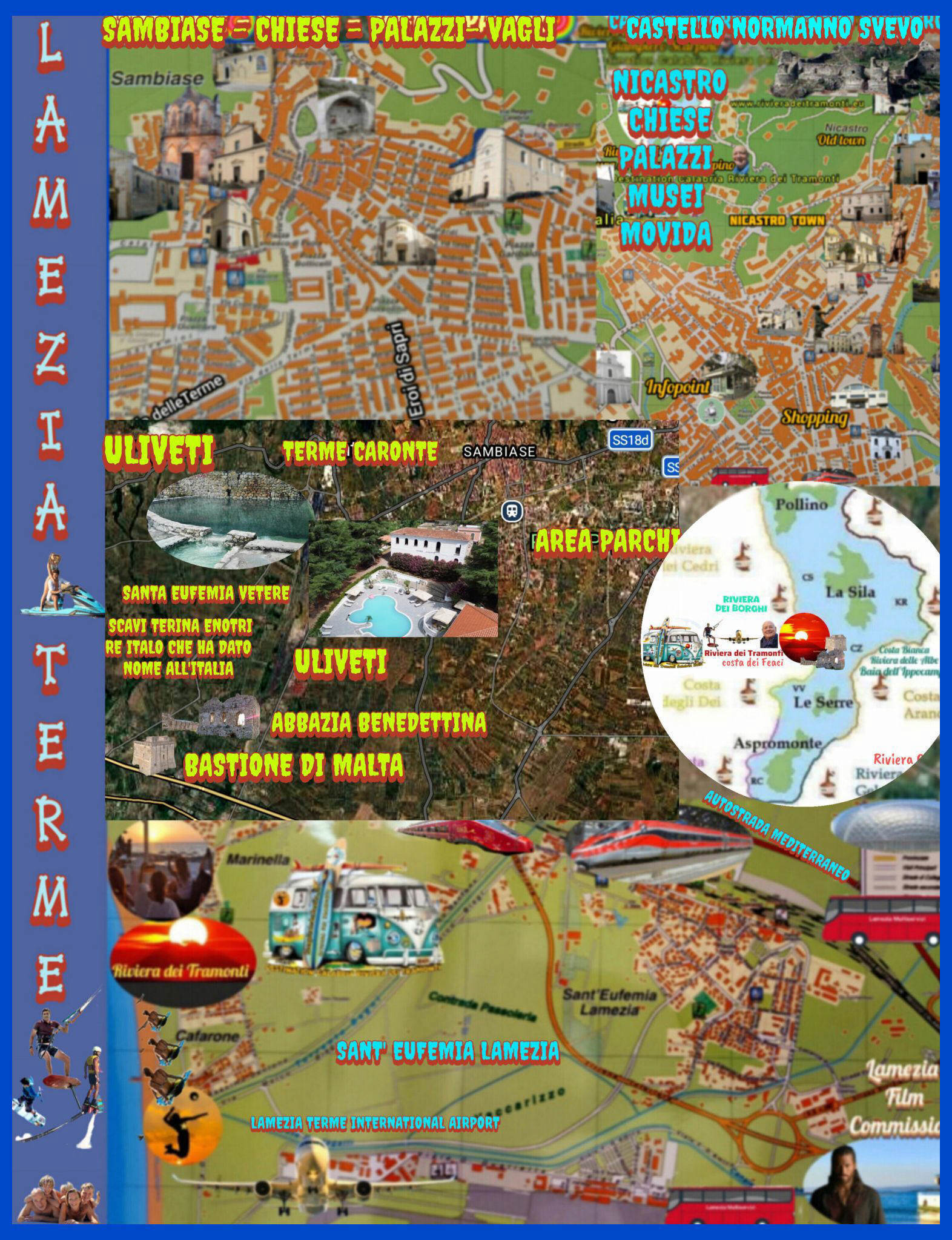
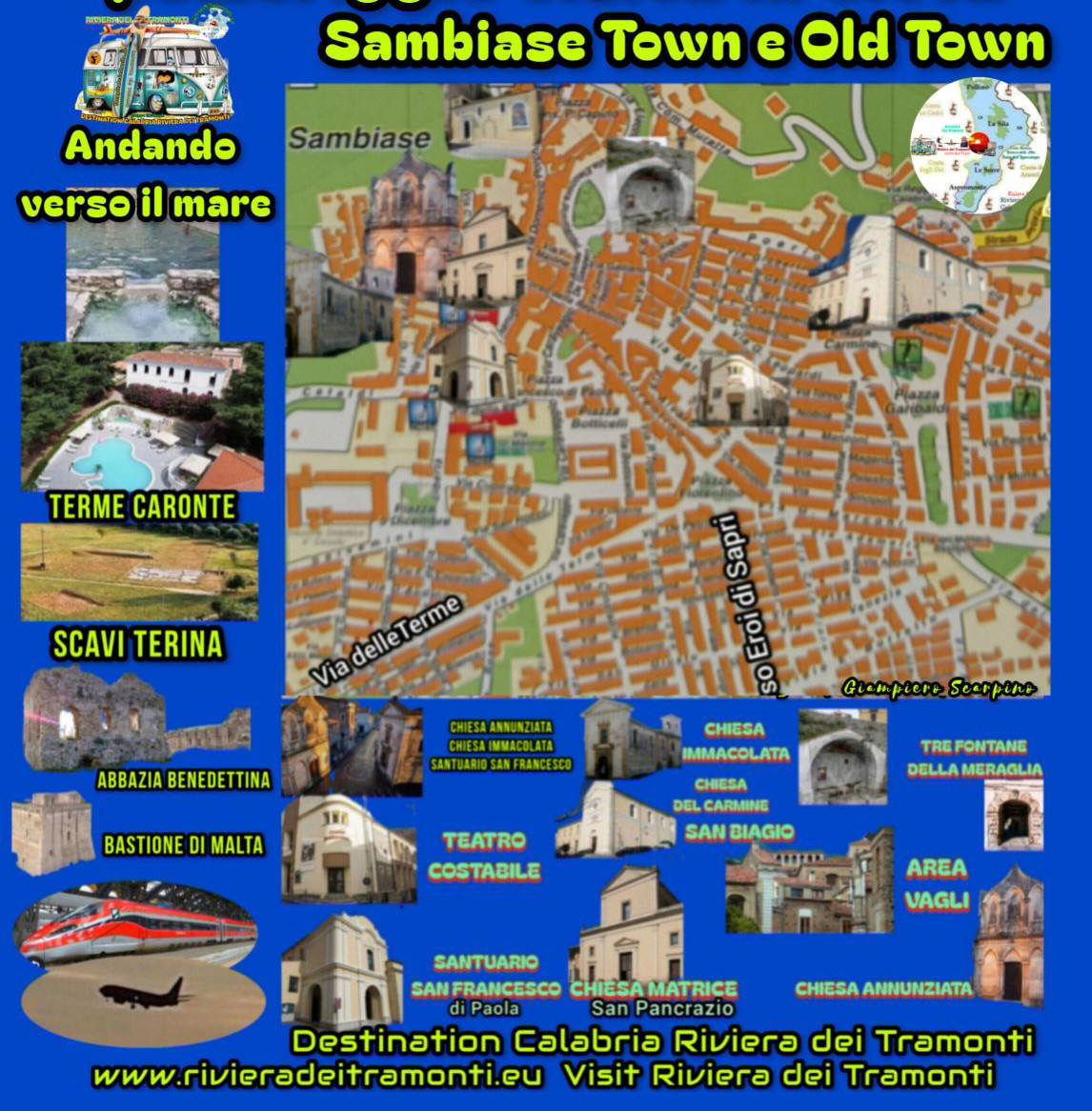
| TERME DI CARONTE: acque sulfureo solfato alcalino terrose iodiche arsenicali che sgorgano a 39"C. La caratteristica della Acque Termali di Caronte si deve alla natura che ha traciato sopra il territorio di Sambiase un percorso sotterraneo di mineralizzazione nei terreni calcarei e cristallini. Le proprietà curative delle acque sorgive sono particolarmente adatte alla cura ed alla prevenzione delle malattie dell'apparato respiratorio e delle affezioni di orecchio, naso e gola. Le terme sono convenzionate. All'esterno del parco termale esiste la cosidetta "Gurna di Caronte" una piscina con acqua termale dove è possibile fare il bagno, frequentato da molti turisti e gente del posto. Erano conosciute dagli antichi bruzi, greci, romani, bizantini, normanni e dagli ispanico-francesi. Le fonti termali di Caronte esistono sin dall'antichità, grandi personaggi della storia italiana e soprattutto della storia europea classica e medievale tra i quali l'imperatore romano Antonino Pio , roberto il Guiscardo, e probabilmente suo fratello Ruggero. L'archeologo Paolo Orsi ribadisce testualmente: "le terme di Sambiase furono conosciute anche nell'antichità per i loro effetti salutari, e tutto induce a credere s'abbiano a identificare con le Aquae Angae di cui vi è anche un ricordo nella bella monetazione terinese. Le acque solfuree della sorgente Caronte hanno proprietà terapeutiche adatte a diverse patologie anche per la loro giusta temperatura, circa 39 °C, che consente di utilizzarle senza alcun intervento. | CARONTE THERMAL BATHS: sulfurous, alkaline, earthy, iodine, and arsenical waters that flow at 39°C. The Caronte Thermal Waters owe their unique properties to nature, which has carved an underground mineralization path in the calcareous and crystalline soils above the Sambiase area. The healing properties of the spring waters are particularly suitable for the treatment and prevention of respiratory diseases and ear, nose, and throat conditions. The spa has a special agreement with the local health authority. Outside the spa park, there is the so-called "Gurna di Caronte," a thermal water pool where you can bathe, frequented by many tourists and locals. They were known to the ancient Bruttians, Greeks, Romans, Byzantines, Normans, and the Spanish-French. The Caronte thermal springs have existed since ancient times, and have been visited by great figures in Italian history and, above all, in classical and medieval European history, including the Roman Emperor Antoninus Pius, Robert Guiscard, and probably his son. Brother Ruggero. Archaeologist Paolo Orsi reiterates: "The Sambiase baths were known in ancient times for their health-giving effects, and everything suggests they are identical to the Aquae Angae, which is also mentioned on the beautiful coinage of Teramo. The sulphurous waters of the Caronte spring have therapeutic properties suitable for various ailments, also due to their ideal temperature, approximately 39°C, which allows them to be used without any intervention. |
| PARCO LETTERARIO FRANCO COSTABILE: l'associazione si propone, oltre all'organizzazione annuale del premio intitolato a Franco Costabile, anche come luogo di incontro e di aggregazione nel nome di interessi culturali, assolvendo alla funzione sociale di maturazione e crescita umana e civile dell'ambiente lametino e calabrese, e si propone inoltre di ampliare la conoscenza della poesia, della cultura letteraria e artistica, del rapporto tra società e cultura attraverso attività quali concorsi letterari ed artistici, convegni, conferenze, proiezioni ecc. nonché attività editoriali. | FRANCO COSTABILE LITERARY PARK: In addition to organizing the annual Franco Costabile Prize, the association also serves as a meeting place and gathering place for cultural interests. It fulfills the social function of human and civil maturation and growth in the Lamezia Terme and Calabrian communities. It also aims to broaden knowledge of poetry, literary and artistic culture, and the relationship between society and culture through activities such as literary and artistic competitions, conferences, lectures, screenings, etc., as well as publishing activities. |
| CHIESA SAN PANCRAZIO SAMBIASE, è la chiesa madre del paese e sorge nel cuore del centro storico dI sambiase su Corso Vittorio Emanuele. L'antico duomo dell'ex comune di Sambiase fu eretto nel XVI secolo per volere dell'università. A poco tempo dalla costruzione della nuova chiesa, un terribile terremoto la rase al suolo e nel 1595 la chiesa fu ricostruita. Nel 1783 fu nuovamente distrutta e ricostruita nel XIX secolo ad una sola navata. Ha una struttura a croce latina, tre navate, abside quadrangolare e cupola racchiusa all'esterno da un tiburio. Di stile neoclassica la chiesa è preceduta da una scalinata in pregiata pietra verde del Reventino. La facciata è caratterizzata dal grande timpano sotto il quale sono posti i suoi portoni laterali e il grande portone principale del duomo. L'interno è molto spazioso e adornato da un prezioso pulpito marmoreo e da un organo ottocentesco, abbellito ulteriormente da pregiati stucchi risalenti al 1815 e 1818 incominciati dall'architetto Pietro Procopio e terminati da Gregorio Cianflone. La navata centrale è dedicata a San Pancrazio ed è coperta da volta a botte abbellita da una serie di riquadri raffiguranti l'Adorazione dei Magi, le Nozze di Cana e il Battesimo di Gesù. Al Pallone è stato attribuito gran parte del ciclo pittorico contenuto dalla chiesa, (san Pancrazio che predica agli eretici e dentro un fastigio in stucco, la Madonna con il Bambino); quelli della volta del presbiterio (la Pentecoste e, in un tondo, Davide che suona l'arpa); quelli del tamburo della cupola (le Quattro Virtù cardinali) e, infine, i Quattro Evangelisti dei pennacchi (la tradizione vuole che uno dei Quattro Evangelisti sia stato realizzato dal Cavaliere Calabrese Mattia Preti).Le navate laterali sono sormontate da volta a crociera e sono delimitate lungo il perimetro laterale degli altari con figure di santi come il Crocifisso, San Luigi, la Madonna di Lourdes, San Giuseppe Cottolengo, San Francesco d'Assisi e San Pancrazio. L'ala sinistra è dedicata al santo Sacramento e termina in direzione dell'altare maggiore con l'omonima cappella che custodisce un'antichissima statua del Sacro Cuore di Cristo. In due pennacchi della cupola sono illustrate alcune scene bibliche, mentre al centro è un Cristo Eucaristia. La navata di destra è intitolata alla Vergine delle Grazie, antica titolare della chiesa, che contiene una bellissima statua lignea della Madonna restaurata recentemente e festeggiata con un triduo dal 5 all'8 settembre. Di particolare pregio la statua di san Francesco d'Assisi, un dipinto a olio di Eduardo Fiore che rappresenta la sacra Famiglia | CHURCH OF SAN PANCRAZIO SAMBIASE, the town's mother church, stands in the heart of Sambiase's historic center on Corso Vittorio Emanuele. The ancient cathedral of the former municipality of Sambiase was built in the 16th century at the behest of the university. Shortly after the new church was built, a terrible earthquake razed it to the ground, and it was rebuilt in 1595. In 1783, it was destroyed again and rebuilt in the 19th century with a single nave. It has a Latin cross plan, three naves, a square apse, and a dome enclosed on the outside by a lantern. Built in neoclassical style, the church is preceded by a staircase made of precious green Reventino stone. The façade is characterized by a large tympanum beneath which are located the side doors and the large main door of the cathedral. The interior is very spacious and adorned with a precious marble pulpit and a 19th-century organ, further embellished with precious stuccoes dating back to 1815 and 1818, begun by the architect Pietro Procopio and completed by Gregorio Cianflone. The central nave is dedicated to Saint Pancras and is covered by a barrel vault embellished with a series of panels depicting the Adoration of the Magi, the Wedding at Cana, and the Baptism of Jesus. Much of the church's pictorial cycle (Saint Pancras Preaching to the Heretics and, within a stucco pediment, the Madonna and Child), and those on the presbytery vault (Pentecost and, in a tondo, David Playing the Harp), have been attributed to Pallone. those of the dome drum (the Four Cardinal Virtues) and, finally, the Four Evangelists of the pendentives (tradition has it that one of the Four Evangelists was created by the Calabrese Knight Mattia Preti). The side naves are surmounted by a cross vault and are delimited |
| CHIESA DEL CARMINE : il convento dei Carmelitani dell'ex comune di Sambiase venne costruito nel 20 febbraio1556 per ordine di mons. Antonio Facchinetti poi Papa Innocenzo IX in un luogo ove ricadevano i ruderi di una piccola chiesa dedicata a S. Giovanni, appartenuta ai Benedettini di S. Eufemia, e presso il sito bizantino di S. Blasio. Era Eremo di Sant'Elia, l'oratorio di San Giovanni e una costruzione dove i padri benedettini dell'abbazia di Sant'Eufemia mandavano i frati con precarie condizioni di salute l'ospedale . La chiesa venne rimaneggiata alla fine del Settecento con la costituzione della volta e del parato a stucchi che all'interno comprende i dipinti murari e all'esterno contorna le finestre della parete destra. Il Convento fu per ben due volte, sede del Capitolo provinciale dei carmelitani. Nel luglio del 1809, tramite una legge, il convento fu soppresso da Gioacchino Murat, mentre tutti i beni furono o incamerati o venduti ai francesi. Nel 1809 con decreto fu affidata ai Padri Minimi che vi officiarono fino al 1886, quando per l'incameramento al Demanio dei beni conventuali, voluto dallo Stato Unitario, questi religiosi dovettero andarsene. Nel 1887 lo Stato consegnò il complesso edilizio all'amministrazione comunale che utilizzò parte del convento adibendolo a carcere mentre la chiesa fu riaperta al culto.Nel 1924 il monsignor Giambro, dopo aver ottenuto dal Comune la piena giurisdizione sulla chiesa del Carmine, la elevò aParrocchia con il titolo di S. Maria del Monte Carmelo.Nel1925 il Vescovo nominò primo parroco della parrocchia don Alfonso Genovese, il quale costruì un asilo, gestito dalle suore delCottolengo, chiusa nel luglio 2013.Nel 1936 la facciata della chiesa venne ristrutturata in stile romano e il prospetto venne cambiato.Nella chiesa della Madonna del Carmine sono presenti varie opere d'arte e statue antiche. Fra queste ricordiamo: Vinea carmeli (Francesco Colelli XVIII secolo, dipinto su muro); Adorazione dei Magi, F. Colelli (XVIII secolo, dipinto su muro); Visione di Sant'Elia, F. Colelli (XVIII secolo, dipinto su muro); sant'Andrea Corsini, F. Colelli (XVIII secolo, dipinto su muro); San Dionisio, F. Colelli (XVIII secolo, dipinto su muro); san Cirillo, F. Colelli (XVIII secolo, dipinto su muro); San Telesforo, F. Colelli (XVIII secolo, dipinto su muro); Trasfigurazione di Gesù F. Colelli (XVIII secolo, dipinto su muro) ; San Michele Arcangelo, F. Pallone (XVIII secolo, dipinto su muro); Madonna delle Grazie F.Pallone (XVIII secolo, dipinto su muro); Porticina di Tabernacolo, allievo di F. Colelli (XVIII secolo, dipinto su legno). Statua della Madonna del Carmelo sull'altare maggiore. Statua di san Biagio compatrono della parrocchia, festeggiato con una grande fiera nei giorni 1-2-3 febbraio. Statua di sant'Antonio da Padova; Statua del Sacro Cuore di Gesù Statua della purificazione di Maria (raffigura la Madonna con Gesù bambino in braccio e due colombe in mano), chiamata anche Madonna della Candelora, perché festeggiata il 2 febbraio con San Biagio. Statua di santa Scolastica ; Statua di san Giuseppe. | CHURCH OF CARMINE: the Carmelite convent in the former municipality of Sambiase was built on February 20, 1556, by order of Monsignor Antonio Facchinetti, later Pope Innocent IX, on the site of the ruins of a small church dedicated to St. John, which had belonged to the Benedictines of St. Eufemia, and near the Byzantine site of St. Blasio. It was the Hermitage of St. Elias, the Oratory of St. John, and a building where the Benedictine fathers of the Abbey of St. Eufemia sent friars with poor health to the hospital. The church was remodeled at the end of the 18th century, with the addition of the vault and stucco decoration, which on the inside includes the wall paintings and on the outside surrounds the windows on the right wall. The Convent was twice the seat of the Provincial Chapter of the Carmelites. In July 1809, the convent was suppressed by law by Joachim Murat, while all its assets were either confiscated or sold to the French. In 1809, by decree, it was entrusted to the Minim Fathers, who officiated there until 1886, when the convent's assets were confiscated by the State, as mandated by the Unified Italian State, and these monks were forced to leave. In 1887, the State handed over the building complex to the municipal administration, which used part of the convent as a prison, while the church was reopened for worship. In 1924, Monsignor Giambro, after obtaining full jurisdiction over the Carmine Church from the Municipality, elevated it to a parish with the title of Santa Maria del Monte Carmelo.In 1925, the Bishop appointed Don Alfonso Genovese as the parish's first parish priest. He built a nursery school, run by the Cottolengo nuns, which closed in July 2013. In 1936, the church's façade was renovated in Roman style and the elevation was changed. The church of the Madonna del Carmine houses various works of art and ancient statues. Among these are: Vinea Carmeli (Francesco Colelli, 18th century, wall painting); Adoration of the Magi, F. Colelli (18th century, wall painting); Vision of Saint Elias, F. Colelli (18th century, wall painting); Saint Andrew Corsini, F. Colelli (18th century, wall painting); Saint Dionysius, F. Colelli (18th century, wall painting); Saint Cyril, F. Colelli (18th century, wall painting); Saint Telesphorus, F. Colelli (18th century, wall painting); Transfiguration of Jesus F. Colelli (18th century, wall painting); Saint Michael the Archangel, F. Pallone (18th century, wall painting); Our Lady of Grace F. Pallone (18th century, wall painting); Tabernacle Door, pupil of F. Colelli (18th century, wood painting). Statue of Our Lady of Mount Carmel on the high altar. Statue of Saint Blaise, co-patron saint of the parish, celebrated with a large fair on February 1st, 2nd, and 3rd. Statue of Saint Anthony of Padua; Statue of the Sacred Heart of Jesus; Statue of the Purification of Mary (depicts the Madonna with baby Jesus in her arms and two doves in her hands), also called Our Lady of Candlemas, because she is celebrated on February 2nd with Saint Blaise. Statue of Saint Scholastica; Statue of Saint Joseph. |
| CHIESA DI SANTA TERESA A PIANO LUPPINO :La chiesa di SANTA tERESA nella frazione Piano Luppino fu costruita e consacrata nel 2004 per volere di don Pasquale Luzzo. La chiesa fa parte della Parrocchia del Carmine.La chiesa è in stile moderno. Sull'altare maggiore è situata una bellissima scultura del "Crocifisso in gloria" e accanto all'altare si trova la statua di Santa Teresa e la copia dell'icona della Madonna del carmine, la cui originale è conservata in parrocchia sulla nicchia della statua. | CHURCH OF SANTA TERESA IN PIANO LUPPINO: The Church of SANTA TERESA in the hamlet of Piano Luppino was built and consecrated in 2004 at the behest of Father Pasquale Luzzo. The church is part of the Parish of Carmine. The church is in a modern style. On the high altar is a beautiful sculpture of the "Crucifix in Glory," and next to the altar is a statue of Saint Teresa and a copy of the icon of the Madonna del Carmine, the original of which is kept in the parish church in the statue's niche. |
| SANTUARIO DI SAN FRANCESCO: la chiesa di San Francesco, conosciuta anticamente con il nome di chiesa della Madonna degli Infermi, risale alla seconda metà del 1400. II 20 giugno 1508,l'arcidiacono della Cattedrale Giovanni De Senatorelli, concede l'esistente chiesa e il convento annesso all'Ordine dei Minimi di san Francesco di Paola . I padri Minimi l'acquisiscono ufficialmente il 3 aprile 1520. Per ringraziare il donatore dopo la sua morte, avvenuta nel 1522, i frati seppelliscono i suoi resti all'interno della chiesa stessa. Il terremoto del 1638 la distrusse completamente e fu poi ricostruita con le offerte dei cittadini. I Minimi vi rimasero fino al 1866, anno in cui dovettero abbandonarlo a causa delle continue soppressioni, per poi ritornarvi occasionalmente fino al 1955, anno in cui la chiesa di San Francesco è diventata parrocchia con i Minimi. Il 2 giugno 2017 la chiesa di San Francesco di Paola viene innalzata a Santuario Diocesano dal vescovo di Lamezia Terme Mons. Cantafora durante la celebrazione della festa in onore di San Francesco. All'interno della chiesa sono custoditi il busto ligneo di San Francesco e la statua della Madonna del Miracolo; | SANCTUARY OF SAN FRANCESCO: The church of San Francesco, formerly known as the church of the Madonna degli Infermi, dates back to the second half of the 15th century. On June 20, 1508, the archdeacon of the Cathedral, Giovanni De Senatorelli, granted the existing church and the adjacent convent to the Order of Minims of San Francesco di Paola. The Minims officially acquired it on April 3, 1520. To thank the donor after his death in 1522, the friars buried his remains inside the church itself. The 1638 earthquake completely destroyed it, and it was later rebuilt with donations from the citizens. The Minims remained there until 1866, when they were forced to abandon it due to continuous suppressions, only to return occasionally until 1955, when the church of San Francesco became a parish with the Minims. On June 2, 2017, the Church of San Francesco di Paola was elevated to a Diocesan Shrine by the Bishop of Lamezia Terme, Monsignor Cantafora, during the celebration of the feast in honor of Saint Francis. Inside the church are kept the wooden bust of Saint Francis and the statue of the Madonna del Miracolo; |
|
Santuario della MADONNA DI PORTO SALVO: è un piccolo e semplice santuario, nel suo interno si custodisce una meravigliosa statua della Madonna di Porto Salvo, insieme alla tela, situata sull'altare maggiore, che raffigura il miracolo della Madonna; CHIESA DELL'ANNUNZIATA: in questa chiesa c'era già, nel 1601, una congregazione religiosa sotto il titolo di S. Giovanni, al quale Santo era intitolata prima la chiesa stessa. Poi la congregazione edificò una propria cappella nella Chiesa Matrice e la chiesa passò al nome dell'Annunziata. Inoltre la chiesa custodisce le statue dei "Mistiari", raffiguranti la passione e la morte di Gesù. La chiesa è conosciuta anche come "chiesa di Santa Lucia" poiché sull'altare maggiore si trova una statua della Santa; CHIESA DELL'IMMACOLATA: edificata probabilmente nella seconda metà del Seicento, è stata sede dell'omonima Congregazione, come si evince da un documento del 1762 indirizzato al re Ferdinando IV di Borbone rinvenuto nella Sagrestia. La chiesa, sull'altare maggiore, possiede una bella statua lignea e antica dell'Immacolata e la altre statue sono: l'Ecce Homo, Gesù Bambino, Santa Caterina, San Giuseppe, San Pasquale e Sant'Anna. È decorata con affreschi sulle pareti e i cittadini ne sono molto devoti; CHIESA DELL'ADDOLORATA: la chiesa è situata nel rione Miraglia. Si narra che anticamente esisteva un ROMITORIO dedicato alla Madonna dei Sette Dolori, e di conseguenza, gli abitanti costruirono la chiesetta. |
SANTUARIO MADONNA DI PORTO SALVO: a small and simple
sanctuary. It houses a wonderful statue of the Madonna of Porto Salvo,
along with a canvas depicting the miracle of the Madonna, located on the
high altar. CHURCH OF THE ANNUNCIATION: in 1601, this church housed a religious congregation dedicated to St. John, after whom the church was originally dedicated. Later, the congregation built its own chapel in the Mother Church, and the church took the name of the Annunciation. The church also houses the statues of the "Mystiari," depicting the passion and death of Jesus. The church is also known as the "Church of Santa Lucia" because a statue of the Saint is located on the high altar. CHURCH OF THE IMMACULATE CONCEPTION: Probably built in the second half of the 17th century, it was the seat of the Congregation of the same name, as evidenced by a 1762 document addressed to King Ferdinand IV of Bourbon, found in the sacristy. The church, on the high altar, features a beautiful, ancient wooden statue of the Immaculate Conception, along with other statues: the Ecce Homo, Baby Jesus, Saint Catherine, Saint Joseph, Saint Paschal, and Saint Anne. It is decorated with frescoes on the walls, and the residents are very devoted to it. CHURCH OF THE ADDOLORATA: The church is located in the Miraglia district. It is said that in ancient times there was a hermitage dedicated to Our Lady of the Seven Sorrows, and consequently, the residents built the small church. |
| ABBAZIA BENEDETTINA, di cui oggi restano soltanto poche tracce, fu fondata intorno al 1062/65 sui resti di un antico monastero bizantino dedicato a Sant'Eufemia. Vanta il primato di essere stata le prima abbazia fondata dai Normanni in Calabria da Roberto il Guiscardo sui resti di un antichissimo monastero bizantino. Le tracce che ancora rimangono hanno evidenziato che la struttura era composta da 3 navate, un transetto che termina in un'abside centrale e due absidi laterali. Luogo di controllo e centro della politica religiosa, economica e del territorio nella carta di fondazione dell'abbazia lo stesso Roberto il Guiscardo dichiara che metà di Nicastro, il Castello e il territorio di Maida e Martirano sono assoggettati alla sua giurisdizione. Fu il terremoto del 1638 a contribuire alla sua distruzione e il conseguente passaggio della giurisdizione all'ordine dell'ospedale di San Giovanni successivamente Ordine dei cavalieri di Malta (1529). ABBAZIA BENEDETTINA VISITA IL SITO | BENEDICTINE ABBEY, of which only a few traces remain today, was founded around 1062/65 on the ruins of an ancient Byzantine monastery dedicated to Saint Euphemia. It boasts the distinction of having been the first abbey founded by the Normans in Calabria by Robert Guiscard on the ruins of an ancient Byzantine monastery. The traces that still remain have shown that the structure was composed of 3 naves, a transept ending in a central apse and two lateral apses. Place of control and center of religious, economic and territorial politics, in the founding charter of the abbey Robert Guiscard himself declares that half of Nicastro, the Castle and the territory of Maida and Martirano are subject to his jurisdiction. It was the earthquake of 1638 that contributed to its destruction and the consequent transfer of jurisdiction to the order of the hospital of San Giovanni, later the Order of the Knights of Malta (1529). BENEDICTINE ABBEY VISIT THE SITE |
DESTINATION CALABRIA RIVIERA DEI TRAMONTI