NICASTRO CENTER
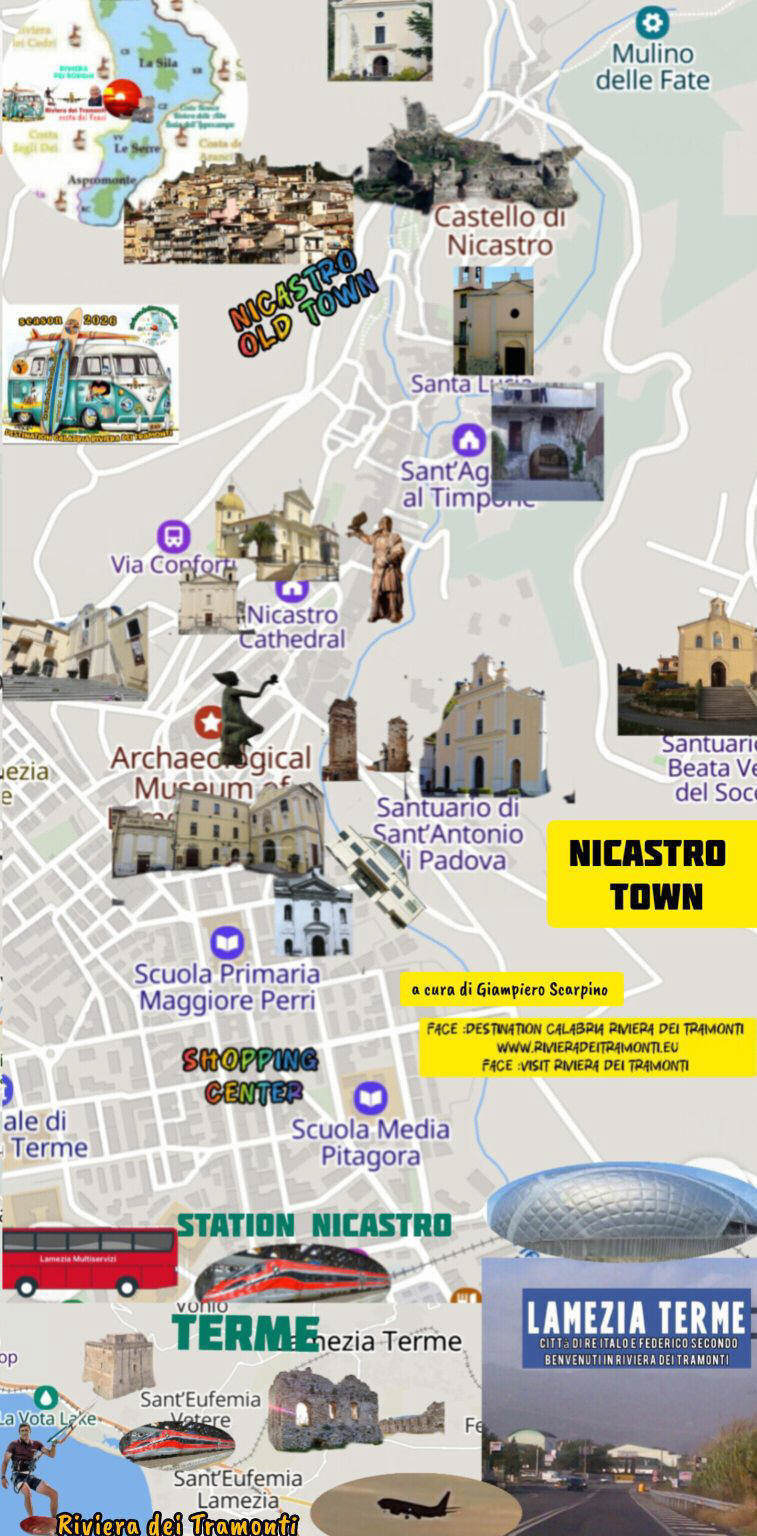
These streets and squares are all located in the historic center of
Nicastro, Lamezia Terme, within walking distance of each other.
* Via Isonzo is one of the main arteries that runs along the center,
facilitating access to the upper district. Its characteristic features
are its narrow street, its small balconies overlooking the street, and
the cloisters that extend all the way to Via Crocefisso and Piazza
Mercato Vecchio.
* Via Crocefisso is a characteristic street that winds through the heart
of the historic district, famous for its shops until a few years ago. It
ends at Via Indipendenza, which leads to the Sanctuary of Sant'Antonio
and the historic bar and Palazzo Ferrise. The bar is now a restaurant.
Piazza Bovio is a central landmark for Nicastro, a lively area in the
1960s known for its open-air market.
Piazza Mercato Vecchio was historically the commercial heart of the
city; today, it is a lively area full of clubs and bars, the hub of
Lamezia Terme's nightlife. Here you'll find the famous Coneria Italiana
and the historic Pasticceria Federico, where you can enjoy the famous "muzzunata"
with brioche.
The steps leading down from Corso Numistrano are historic and evocative.
From the square, you can access the historic Palazzo Nicotera-Severisio,
which, along with Piazza Mercato Nuovo, represent two hubs of city life,
for culture and daily commerce respectively. The former is an important
historic residence located in Piazzetta Tommaso Campanella, while the
latter houses the lively Mercato Coperto. Palazzo Nicotera was built in
the mid-18th century by Domenico Nicotera. This building is an example
of Calabrian courtly architecture, reflecting the taste of the
aristocracy of the time.
Today, it houses the "Oreste Borrello" Municipal Library, the Casa del
Libro Antico (House of Ancient Books), and the Lamezia Terme Library
System.
It is also known as the "Palazzo delle Monachelle" (Palace of the Nuns)
because in the 19th century it was a children's institute run by nuns.
There was a "wheel" for abandoning newborns.
The building served as a courthouse during the 20th century before being
purchased by the municipality in the 1990s.
Piazza Mercato Nuovo is located a short distance from the main roads of
the center; the square is the historic commercial heart of the
neighborhood. In the evening, the square comes alive with many highly
sought-after eateries serving fine food, along with those in Piazza
Stocco behind Corso Numistrano, under the Cathedral.
Mercato Coperto: This market is the go-to place for purchasing local
products, generally open Monday through Saturday from 6:00 AM to 1:00
PM.
These locations form an ideal route for strolling among the historical
beauties and noble palaces of the Nicastro neighborhood.
SAN DOMENICO MONUMENTAL COMPLEX
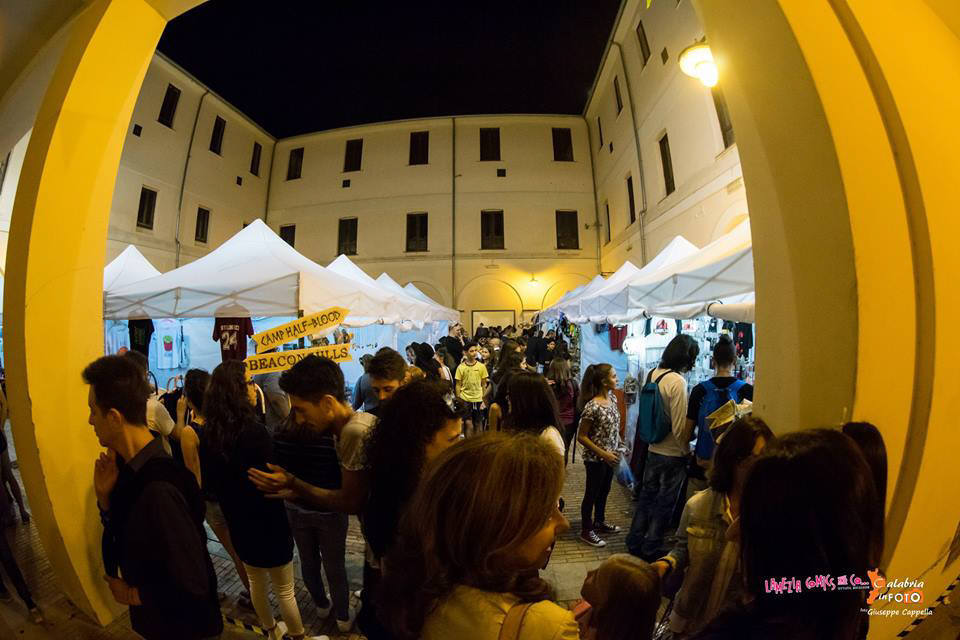
The San Domenico Monumental Complex, located in the heart of Nicastro in
Lamezia Terme, is one of the city's most important cultural centers.
Founded as a Dominican convent in 1506, the building has hosted
illustrious figures such as the philosopher Tommaso Campanella, who
studied there in 1598. For years, it was home to the historic Francesco
Fiorentino Classical High School.
Today, the complex is a multifunctional center that includes:
The Cloister: A recently restored, evocative space that serves as the
hub for cultural events, exhibitions, and festivals such as Trame.
* Lamezia Terme Archaeological Museum: Located on the first floor, it
houses artifacts that tell the story of the Lamezia plain from the
Paleolithic to the Middle Ages.
Hours: Usually open Tuesday to Saturday, 9:00 AM - 7:00 PM (closed
Sundays). It is recommended to check the current status as some sources
report it as temporarily closed.
Cost: Admission is free.
The complex regularly hosts initiatives such as educational workshops
for children (e.g., "Minecraft on the Trail of History"), photography
exhibitions, and the famous Trame Festival (a festival of books about
the mafia).
Let's recap: the Cloister of San Domenico, located in the heart of the
Nicastro district of Lamezia Terme, is one of the city's main cultural
centers. Part of the Monumental Complex of San Domenico, it now houses
the Chiostro Caffè Letterario and the Lamezia Terme Archaeological
Museum. The complex was founded in 1501 by Count Marcantonio Caracciolo
and entrusted to the Dominican Fathers. Illustrious Guests: Between 1586
and 1588, the philosopher Tommaso Campanella stayed here to further his
studies in the convent's extensive library.
Transformations: After the violent earthquake of 1638, the entire
complex was rebuilt in Baroque style. Over the centuries, the building
has changed functions several times, serving as military barracks and as
a secondary school.
The cloister is now a lively social and cultural hub, a space for
reading, studying, and socializing, equipped with a café and a small
library.
* Lametino Archaeological Museum: Located on the first floor of the
complex, it houses artifacts from prehistory to the Middle Ages from the
surrounding area.
The courtyard regularly hosts concerts, book presentations, photography
exhibitions, and nationally important festivals such as Trame and the
Ormeggi Festival.
Literary Café Hours: Tuesday to Saturday: 5:00 PM –9:00 PM
* Sunday and Monday: Closed.
The facility also hosts archery courses and meetings of the local chess
association.
TIMPONE NEIGHBORHOOD
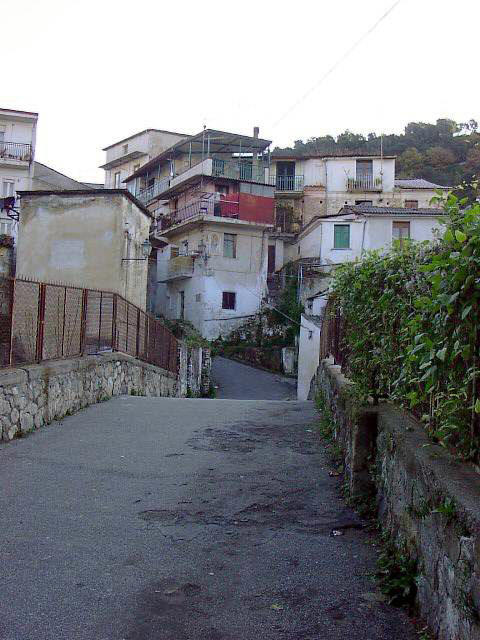
The Timpone neighborhood of Nicastro (Lamezia Terme) is the
ancient Giudecca, the historic district that was home to the
city's Jewish community between the 13th and 16th centuries. It
is characterized by a perched and secluded location, situated on
a hill surrounded by the Barisco and Canne streams, which served
as a natural defense for the village.
The Giudecca: The neighborhood is identified by historians as
the place where Jews lived and worked. Unlike compulsory ghettos,
the Giudeccas were often chosen for reasons of safety and
protection of cultural identity. The proximity to the streams
allowed the development of specific professions. The inhabitants
of the Timpone were known as expert tanners, dyers, and tailors.
The Timpone is an intricate labyrinth of narrow alleys,
stairways, and underpasses. Access was once regulated by a
single entrance that was closed in the evening.
A tourist attraction is the Church of Sant'Agazio. Located in
the heart of the neighborhood, it is a simple building with an
Ionic façade. According to some historical theories, it may have
stood on the site of an ancient mosque or synagogue, although
this debate among experts is still ongoing.
A commemorative plaque at the entrance to the neighborhood
officially recalls its Jewish roots. nel quartiere. Gli ebrei
locali erano esperti nella tessitura, tintoria e lavorazione del
ferro.
.
BELLA NEIGHBORHOOD AND ITS CHURCHES
In the Bella neighborhood of Lamezia Terme, the main religious landmarks
are the Church of the Nativity of the Blessed Virgin Mary and the
Sanctuary of the Madonna della Spina.
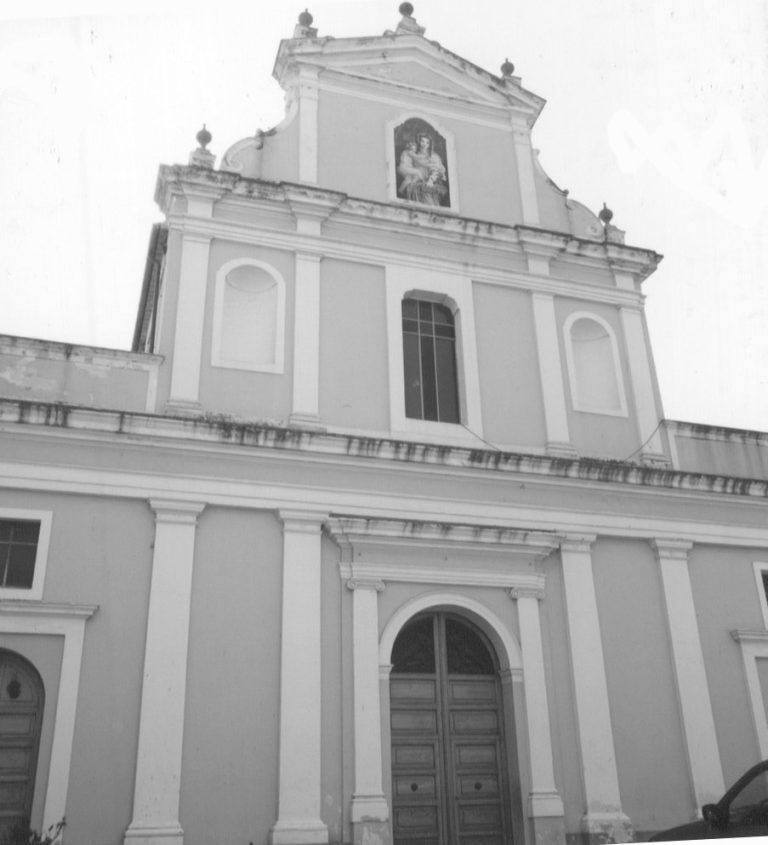
Church of the Nativity of the Blessed Virgin Mary.
Also known as the Church of Santa Maria delle Grazie, it is the parish
church located in the neighborhood's main square, Piazza Roma.
Originally built in 1835 with a single nave, it was later expanded to
three naves between 1867 and 1883. The monumental façade houses a fresco
of the Madonna and Child.
Characterized by decorated barrel vaults, exquisite frescoes, and
ornamental stucco.
The patronal feast dedicated to Mary, Mother of All Graces, is
celebrated on September 8th.
Sanctuary of the Madonna della Spina
Located in the highest part of the neighborhood, this small sacred
building is linked to an ancient folk tradition.
It is said that a farmer had a vision of the "Beautiful Lady" who told
him to cut down a thorn bush, revealing an ancient fresco of the Madonna
and Child.
The church has a simple façade with an arched portal and a bell tower
with three bells, one dating back to 1663.
The feast of the Madonna della Spina, with its traditional procession,
is held every year on May 31st.
ARCH OF SAINT ANTHONY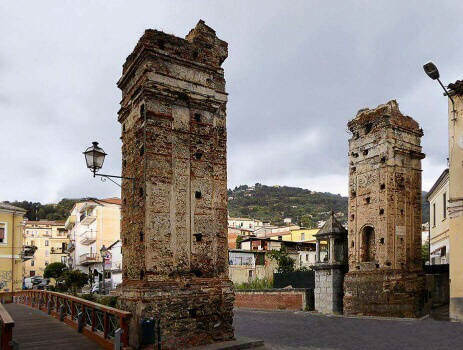
This is the Arch of Saint Anthony in Nicastro di Lamezia Terme, a
historic structure located in the Nicastro district, originally built
over a masonry bridge that crossed the Canne stream.
The arch was built around 1685 at the behest of Father Antonio da
Olivadi, superior of the Capuchin monastery.
It was built along with a masonry bridge (which replaced an earlier
wooden one) to facilitate the passage of pilgrims heading to the
sanctuary.
Atop the arch was a small stone statue of Saint Anthony facing the city
of Nicastro, symbolizing the Saint's protection of the community. The
arch no longer exists; it was demolished in the past because it was
considered unsafe following structural work.
The Arch of Saint Anthony in Lamezia Terme was a historic structure
located in the Nicastro district, originally built over a masonry bridge
that crossed the Canne stream.It was the Capuchin Father Antonio da
Olivadi, the same man who commissioned the current Nicastro statue of
the patron saint in Naples, who had the masonry bridge built around
1685, replacing the wooden one, to facilitate pilgrims' access to the
convent. The bridge was also surmounted by the large arch, at the top of
which was placed a stone statue of the Saint facing the city. The arch
collapsed following the terrible earthquake of 1783, but miraculously
the statue was recovered intact from the rubble and relocated to a niche
on the façade of the Capuchin church, above the main entrance, where it
remains today. It is still possible today to admire the bridge and the
arch in their original form in a splendid drawing dated around 1760,
preserved in the State Archives, which portrays the view of the “Piazza
Grande di Nicastro”, approximately the current Piazza Mercato Vecchio:
this outlet, which was accessed via the bridge, was an obligatory
passage point, and also a point of trade, along the route connecting the
two seas, on the northern side of the Lamezia plain. (Partly source Il
Lametino).
CORSO NUMISTRANO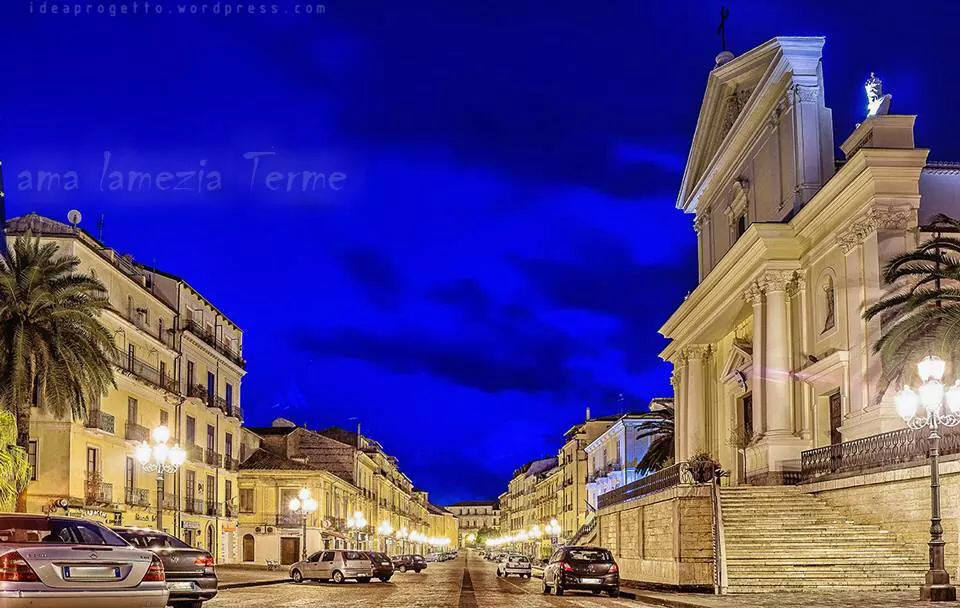
Corso Numistrano is the historic heart and "salon" of Lamezia Terme,
located in the Nicastro district. It is one of the city's most elegant
urban spaces, characterized by wide sidewalks and a lively urban
atmosphere, ideal for a stroll among monuments, shops, and historic
venues. What to see: The avenue is home to some of the city's main
religious and cultural symbols:
Cathedral of Saints Peter and Paul, Lamezia Terme's main place of
worship. Recently restored, it houses valuable works of art such as
silver busts and a monumental pulpit. The Church of Santa Caterina, the
Monumental Complex of San Domenico, located at the intersection with
Corso Giovanni Nicotera, includes the church of the same name (where the
philosopher Tommaso Campanella studied) and the cloister, now home to
the Lamezia Terme Archaeological Museum.
Continuing toward the end of the street and towards the mountains that
mark the beginning of the pre-Sila, you'll come across the statue
dedicated to the Swabian Emperor Frederick II, which dominates the view
of the Norman-Swabian Castle located on the hill above. After the
statue, you'll climb towards the characteristic neighborhoods of Santa
Lucia with the church of the same name, Largo Statti with the historic
Palazzo Statti, and then uphill towards San Teodoro and the Castle.
Corso Numistrano is a major destination for leisure and nightlife:
Historic bars on Corso Numistrano are popular spots for breakfast,
aperitifs, and evenings with live music.
On Corso Numistrano and the adjacent Salita Maruca, as well as Via
Lissania and Piazza Stocco (or San Giovanni), you'll find numerous fine
dining establishments and cocktail bars offering sophisticated drinks
and a trendy atmosphere.
Along the street are historic businesses such as jewelry shops.
International airline advertisements call it the "city lounge" and "the
goldsmiths' street." Nicastro's historic newsstands and pharmacies are
also present.
The name "Numistrano" derives from a local scholarly legend according to
which Nicastro was founded on the ancient city of Numistro. Although it
is a busy street, there are recent proposals to transform it into a
pedestrian area on weekends to improve its liveability.
The descent leading to Piazza Mercato Vecchio passes adjacent to the
monumental complex of San Domenico:
THEATER UMBERTO
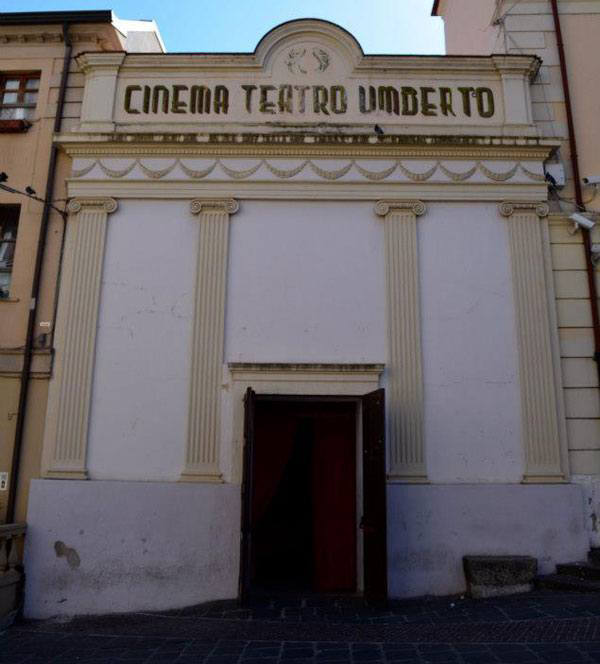
The Teatro Umberto in Lamezia Terme, located in the historic Piazzetta
San Domenico (Nicastro), is currently undergoing a major restoration and
redevelopment project. Although historically known as "il Pidocchietto"
(the Pidocchietto) and appreciated for its neoclassical architecture and
excellent acoustics, the structure has been closed to the public in
recent years for safety and deterioration reasons.
Restoration work, funded through the Urban Agenda, was awarded in
December 2025, with the aim of returning this "little gem" with
approximately 120 seats to the city.
The theater is currently undergoing renovation (work began at the end off
SAN TEODORO AND SANTA LUCIA
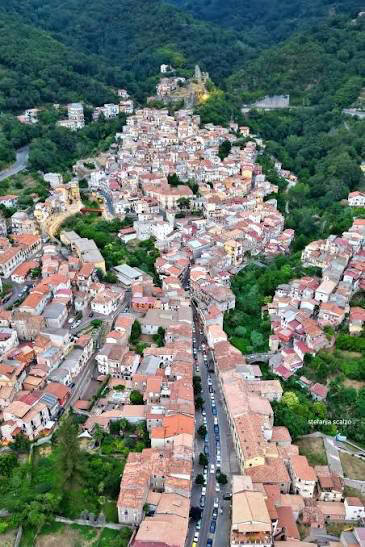
FOTO FACE CENTRO STORICO NICASTRO
San Teodoro and Santa Lucia are two of the oldest and most evocative
neighborhoods of Nicastro, one of the historic centers of Lamezia Terme.
Both are located in the upper part of the city, characterized by narrow
alleys, stairways, and an atmosphere of times gone by.
Santa Lucia District
Located not far from San Teodoro, the Santa Lucia neighborhood
represents another cornerstone of Lamezia Terme's tradition. The parish
is the cornerstone of the neighborhood. Officially named S.S. Nicola e
Lucia, it is one of Nicastro's four historic parishes. The oldest parish
registers date back to the late 17th century. The saint is highly
venerated, especially as the protector of sight. Inside the church is a
precious 18th-century wooden statue of Saint Lucia.
The neighborhood extends across the northern part of Nicastro and,
together with the neighboring Timpone district, forms a labyrinth of
narrow streets descending toward the modern city center. Nearby, the
Norman-Swabian Castle, accessible by climbing from San Teodoro, offers a
panoramic view of the entire Sant'Eufemia plain, the Riviera dei
Tramonti, and the historic Costa dei Feaci.
The Piedichiusa Park is a regenerated green area connecting the historic
neighborhoods, ideal for urban trekking. It's described as very
beautiful.
Finally, Corso Garibaldi, the main street that marks the boundary
between the old town and the modern city, is home to the statue of
Frederick II. The photo is by the talented Stefania Scalzo, who manages
the Centro Storico Nicastro Facebook page. You can see many photos there.
Stefania is the creator of the Riviera dei Tramonti logo, a logo she
designed free of charge to accompany the fantastic idea of the Riviera
dei Tramonti tourism brand.
SAN TEODORO
San Teodoro, the neighborhood born at the foot of the Norman-Swabian
castle.
It is considered the beating heart of the medieval village, located
right at the foot of the Norman-Swabian castle. It developed around the
fortress starting in the 11th century. Historically, it was protected by
the city walls and is still the neighborhood that best preserves its
original urban layout. Inside, the beautiful Church of San Teodoro
stands out, a key point of reference for the community. Although the
parish is very ancient (mentioned as early as 1500), the current
structure retains the charm of the small neighborhood churches that once
served the rural population and artisans. The neighborhood is famous for
its fountains and its proximity to the Niola stream, which once powered
the area's mills.
SAMBIASE TOWN AND OLD TOWN
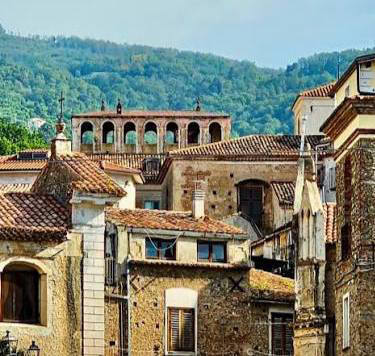
Sambiase, the historic district of Lamezia Terme, is home to a rich
religious heritage, concentrated primarily in its ancient heart. Among
the most significant places of worship to visit are the Sanctuary of San
Francesco di Paola, the Mother Church of San Pancrazio, and the unique
Church of the Annunziata.
Here are the main churches not to be missed in the historic center:
Sanctuary of San Francesco di Paola. Dedicated to the patron saint of
Calabria and Sambiase, the church, dating back to the 1400s, features a
portico decorated with frescoes depicting the life of the saint and a
single-nave interior with a valuable "Fanzago"-style altar.
Maternal Church of San Pancrazio. This is the neighborhood's main church
and stands in the heart of the historic center. It houses side altars
dedicated to various saints and remarkable stucco decorations.
Church of the Annunziata. Distinctive for its Gothic-style façade with
Arabic accents. The interior consists of two naves and, together with
the nearby Church of the Immaculate Conception, represents an important
historical landmark for the ancient local congregations.
Church of the Blessed Virgin of Mount Carmel.
Located in the Cafaldo district, it is dedicated to the cult of the
Virgin of Mount Carmel and Saint Blaise.
The Church of the Immaculate Conception is a historic small church
historically linked to the local population, located a short distance
from the Annunziata.
Most of these churches are located within a few minutes of each other,
making the historic center of Sambiase easily explored on foot.
SANCTUARY OF
SAINT ANTHONY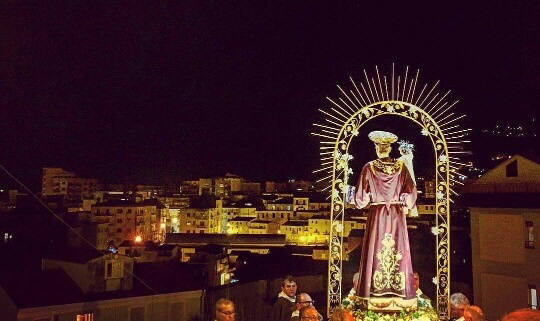
The Sanctuary of Saint Anthony of Padua in Nicastro (Lamezia Terme) is
one of Calabria's main centers of spirituality, deeply rooted in the
history and identity of the local community. The first Capuchin Friars
arrived in Nicastro around 1545 (some sources cite 1540), summoned by
Count Ferdinando Caracciolo. They initially built a convent dedicated to
Our Lady of Santa Maria degli Angeli. The 1638 Earthquake: A crucial
event was the catastrophic earthquake of 1638. According to tradition,
the convent remained standing thanks to the intervention of the Saint,
while much of the city was destroyed.
Following the damage, the complex was rebuilt on a larger scale in 1639.
Although the church is officially dedicated to Santa Maria degli Angeli,
it is universally known as the Sanctuary of Saint Anthony due to the
immense popular devotion paid to it.
Modern Evolution: In 1924, it became a novitiate and in 1954, it housed
a missionary center. It was officially erected as a Sanctuary on June
13, 1969.
The structure, originally a single nave, is now divided into three naves
that house important art treasures: the High Altar: houses a large
canvas depicting the Madonna degli Angeli, Saint Francis of Assisi, and
Pope Innocent III. The "Divine Painting": dated 1664, it is a valuable
work by the Roman painter Giacomo Stefanone. It depicts the Saint
wearing the habit of the Friars Minor and is credited with numerous
miracles.
The Statue of the Saint: commissioned in 1685 by the Venerable Father
Antonio da Olivadi, the statue is unique because it depicts Saint
Anthony wearing the habit of the Capuchin Friars, custodians of the
sanctuary.
Painting of the Immaculate Conception: housed in one of the side aisles,
it is the work of the renowned Calabrian artist Andrea Cefaly.
The connection with the city is particularly evident during the
celebrations of June 13th, preceded by the traditional "Tredicina."
Saint Anthony is considered the "popular" protector of the Lamezia Terme
community, a symbol of refuge and hope since the earthquake.
Next to the Sanctuary is the historic former hospital in a large monumental complex which today houses the friars' cells and the non-visitable library.
PIAZZA MAZZINI
Piazza Mazzini (historically known as Piazza d'Armi) is one of the most
iconic sites in the historic center of Nicastro, Lamezia Terme. It once
served as a space for military training and parades, but today it is the
beating heart of the area's social and commercial life, undergoing
recent urban regeneration projects.
The square and its immediate surroundings offer several historic
features and local activities. There are now also a literary café and
some good restaurants in the adjacent side streets.
Formerly called the "Fontana Grande," this historic fountain was
designed in 1838 by engineer Basilio Frangipane. It is located within
the municipal park bordering the square and was recently restored to its
former glory.
A majestic, centuries-old Platano Secolare tree dominates the square and
is considered part of the city's historic tree heritage.
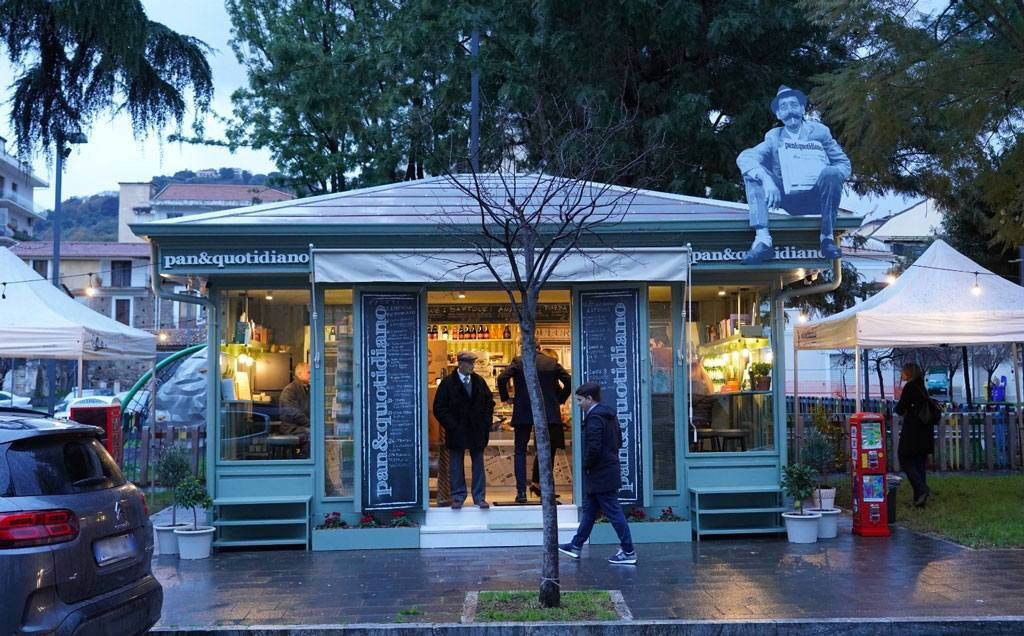
Commercial Activities: Among the historic and new-generation businesses,
the Armi Sport Costantino gun shop (open since 1940) and the
Pan&Quotidiano literary café, a hub for aperitifs and traditional
Calabrian products, stand out.
Near the square: just steps away is the Grandinetti Theater, a cultural
center for performances and concerts.
The square is at the center of the "CRESCO" commercial redevelopment
project, aimed at improving urban decor and safety, making it a meeting
place for open-air exhibitions and markets.
CHURCH OF SAN DOMENICO
The Church of San Domenico in Lamezia Terme (in the Nicastro
district) is one of the city's most important religious monuments, known
for its Baroque splendor and historical connection to the Dominican
order. Originally founded between the 15th and 16th centuries as the
small church of the Annunciation, it was almost entirely rebuilt after
the 1638 earthquake.
The building features a single nave structure richly decorated with
stucco and valuable frescoes. Numerous paintings are attributed to
Francesco Colelli, a student of Mattia Preti, including the "Transfiguration"
and "The Embrace of Saint Francis and Saint Dominic."
The pipe organ, located above the choir, dates back to the late 17th
century and is one of the oldest in the city.
The Crypt is a fascinating place that preserves ancient artefacts and "drainage
tombs," once used for the burial of friars and nobles.
Adjacent to the church is the former Dominican convent, which now houses
the Lametino Archaeological Museum and the Cloister of San Domenico.
The famous philosopher Tommaso Campanella also studied in this church
between 1586 and 1588.
CHURCH
OF SAN TEODORO AND CUCCHIARELLE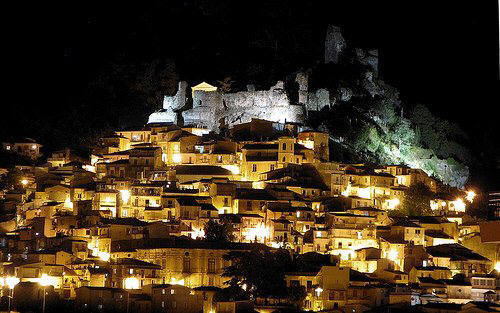
In the Church of San Teodoro in Nicastro (Lamezia Terme), the
statues depicting the Madonna and Jesus are not a single
sculptural group, but are primarily identified as Our Lady of
Sorrows and the Dead Christ.
Within the parish and the nearby branch church of Veterana, the
artistic heritage associated with these figures includes:
* Our Lady of Sorrows: One of the six main statues housed in the
parish church. It is the protagonist, along with the dead Christ,
of the evocative Good Friday procession, during which the Virgin
symbolically "accompany[s]" her dead son through the streets of
the old town.
* Dead Christ: Statue used for the rites of the Passion, also
housed in the parish church of San Teodoro.
* Sacred Heart of Jesus: Another statue dedicated to the figure
of Jesus present in the church.
* Madonna delle Grazie: A statue preserved in the Church of the
Veterana (a branch of San Teodoro), which also houses a canvas
of the same name and a depiction of Our Lady of Sorrows dating
back to 1702.
* Deposition from the Cross: A work by Giorgio Pinna created in
1968, located in the Church of the Veterana, which replaced an
earlier work by Colelli stolen in the 1960s.
The Church of San Teodoro, located at the foot of the
Norman-Swabian Castle, is, as mentioned, the heart of the oldest
district of Nicastro and retains a classical Baroque style in
the central nave, with an important polychrome high altar from
1816.
The Church of the Veterana (also known as Santa Maria della
Veterana or "della Cucchiarella") is considered the oldest
religious building in Nicastro, now part of Lamezia Terme.
Perched on a rocky spur in the San Teodoro district, it
dominates the surrounding plain and offers a picturesque view.
Its origins are shrouded in a medieval legend dating back to
1240: it is said that Our Lady of Graces appeared in a dream to
a daughter of Frederick II, asking her to build a church on the
hill facing the castle where the imperial family resided. The
church likely dates back to the 13th century. It was severely
damaged by the 1638 earthquake and subsequently rebuilt.
The structure is characterized by the great simplicity typical
of the traditional religious architecture of the area. The
gabled façade features a round-arched portal and a small
single-lancet window above.
* Interior: Single nave with wooden ceiling and smooth walls. It
houses valuable paintings, including one depicting the Madonna
with the Swabian princess prostrate at her feet.
The Tradition of the "Cucchiarelle": The church is famous for
the Easter pilgrimage associated with the "cucchiarelle." These
are small tin spoons (ex-votos) that are hung at the church
entrance as a symbol of devotion and protection, a unique
tradition still deeply felt in the San Teodoro neighborhood.
Unfortunately, the church may be closed to the public for
extended periods outside of holidays. It is recommended to.
Check special openings during the Easter period Pasqua
SAMBIASE AND THE VAGLI
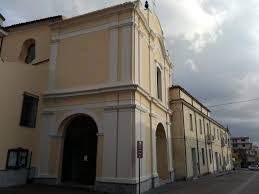
From online searches, what to see in Sambiase: historic buildings
and the "vagli".
The historic center of Sambiase, one of the urban centers of Lamezia
Terme, preserves numerous buildings that testify to the area's noble
and rural past. Many of these are distinguished by their
characteristic "Vagli," stone portals that once provided access to
the internal courtyards of noble palaces.
Main Palaces and Historic Residences
* Palazzo Nicotera: Located in the Calvario district, it is famous
for being the residence of the patriot and Minister of the Interior
Giovanni Nicotera. In the past, it also housed a hospital and a
Carabinieri barracks. A distinctive feature is the "Vaglio di via
Verdi," which originally served as the main entrance before the
structure was divided.
* Palazzo Comunale (formerly the Monastery): Located on Corso
Vittorio Emanuele, the building was formerly a monastery of the
Minim Fathers of San Francesco di Paola.
* Palazzo Greco Stella: Located in Piazza Salvo D'Acquisto, it is a
renovated historic building that now houses a hotel and a bistro. It
retains period flooring and a refined architecture with wooden
mansard structures.
* Palazzo Renda: One of the notable residences located in the
Miraglia district.
* Case Palazziate: The urban fabric is rich in "case palazziate" (palatial
houses) that belonged to local wealthy families:
* Casa Cataldi: Found in both the Calvario and Pietraliscia
districts (the latter being home to the Emergency Medical Service).
* Casa Majone: Located in the Annunziata district.
* Casa Procopio/Mauro: In the Chiesa Matrice district.
* Casa Paladino: Another example of a residence of local notable
families.
Architectural Features and Vagli
Many of Sambiase's noble palaces are built of brick and feature
18th-century friezes or Art Nouveau details. A local peculiarity are
the Vagli, masonry passages or stone portals:
* Vaglio di Porchia: Located on Via Cittadella, it provides access
to the residential complex of the Porchia brothers (a magistrate and
a notary).
* Vaglio di Palazzo Scalfaro: Located behind the Sambiase Cathedral,
it is now privately owned. [3, 4]
If you wish to visit them, the best way is to stroll through the
Calvario, Miraglia, and Annunziata districts, where most of these
buildings are concentrated.
The Vagli di Sambiase are a distinctive architectural feature of the
historic center of Sambiase (one of the three municipalities that
today make up Lamezia Terme), in Calabria.
CATHEDRAL OF SAINTS PETER AND PAUL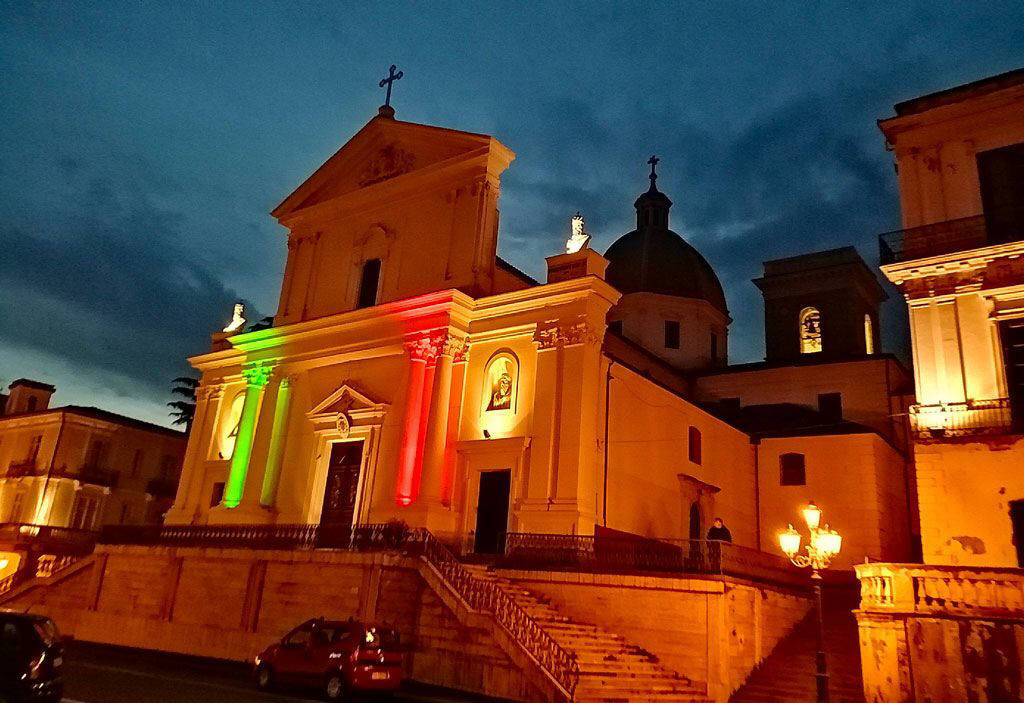
The Cathedral of Saints Peter and Paul, located in the heart of the
historic center of Nicastro on Corso Numistrano, is the main place of
worship and episcopal seat of the Diocese of Lamezia Terme.
The current building dates back to the mid-17th century, but its history
is linked to several reconstructions due to the strong earthquakes that
struck the area:
Norman origins: A first cathedral was built around 1100 by Countess
Eremburga, but was razed to the ground by the 1638 earthquake.
Baroque reconstruction: The current building was begun in 1640 at the
behest of Bishop Giovan Tommaso Perrone.
Characteristics: The neoclassical façade is decorated with busts of the
patron saints and two popes, while the interior features an octagonal
majolica dome and an inlaid choir.
The Cathedral of Saints Peter and Paul in Lamezia Terme (Nicastro) is
the city's main place of worship.
The Cathedral houses the remains of Monsignor Vittorio Moietta, Bishop
of Nicastro from 1961 to 1963. He is beloved by the faithful of Lamezia
Terme, and his cause for sainthood is currently underway (he is a
Servant of God). In 2024, an oil painting on canvas depicting Bishop
Moietta was donated to the Cathedral, along with a crystal urn intended
to collect the prayers and requests for intercession of the faithful
near his tomb.
The Cathedral houses an altar dedicated to Saint Pier Giorgio Frassati (recently
canonized in 2025). The site is a constant place of prayer for the young
people and faithful of the diocese.
Although the Cathedral has been described in the past as "bare," it
houses works of great historical and artistic value:
Madonna del Rosario: Inside, there is a work dedicated to the Virgin of
the Rosary. Note that a rich iconography of the Madonna of the Rosary,
with paintings by Francesco Colelli, is also housed in the nearby Church
of San Domenico.
Silver Busts: The precious busts of Saints Peter and Paul, patron saints
of the city.
Apse: A grandiose canvas (9 x 4.5 meters) by Prof. G. Savini (1997)
dominates, depicting Saints Peter and Paul at the feet of the Assumption.
An 18th-century carved wooden choir and a majestic pipe organ from 1960
are also featured. The current façade is the result of renovations
carried out between the late 19th century and 1925, which transformed
the original Baroque structure into a Neoclassical style. It features
four monumental busts depicting the titular saints, St. Peter and St.
Paul, and Popes Marcellus II and Innocent IX (both bishops of Nicastro).
The church is preceded by a striking double staircase overlooking Corso
Numistrano.
The dome is entirely covered in colorful majolica tiles, an iconic
feature of the city skyline.
CHURCH OF SANTA MARIA MAGGIORE
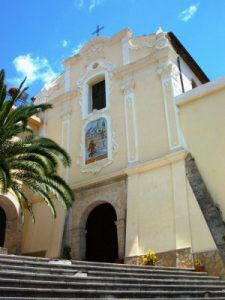
The Church of Santa Maria
Maggiore in Nicastro (Lamezia Terme) is one of the most characteristic
places of worship in the historic center, famous above all for its
imposing Baroque staircase that dominates the surrounding urban space.
Located on Via Enrico Colosimo, the church stands not far from the
Cathedral and represents a historical and spiritual landmark for the
community.
The current building, once part of the ancient convent of the Reformed
Fathers founded in 1240, features a remarkable architectural structure:
The wide staircase leads to the main entrance, characterized by a
Baroque façade divided into two orders with pilasters and Corinthian
capitals.
Internal Structure: The interior is divided into two naves by round
arches. The central nave is covered by a barrel vault decorated with
stucco and frescoes depicting episodes from the life of Saint Francis.
Works of Art: Of particular note is the Baroque high altar, which houses
a small temple and the statues of Saint Clare, Saint Rose of Viterbo,
and two angels, surrounding the statue of the Madonna Assunta. Inside,
there is also a painting attributed to Mattia Preti.
Although the current parish church dates back to 1883, the parish has
ancient roots, with documents attesting to its existence as early as
1513.
Originally located in the Terravecchia district, the church was
destroyed by the flooding of the Piazza stream in 1876, leading to the
transfer of the faithful to the church of the former monastery of San
Francesco.
Former Prison: The adjacent former Franciscan convent was once used as a
penal institution (Nicastro prison).
In the immediate vicinity, you can also visit the Cathedral of Saints
Peter and Paul and the ruins of the Norman-Swabian Castle overlooking
the San Teodoro district. It's beautiful to sit on the steps leading up
to the church square. An ideal place for an open-air cinema in summer.
PROCESSION OF SAINT ANTHONY
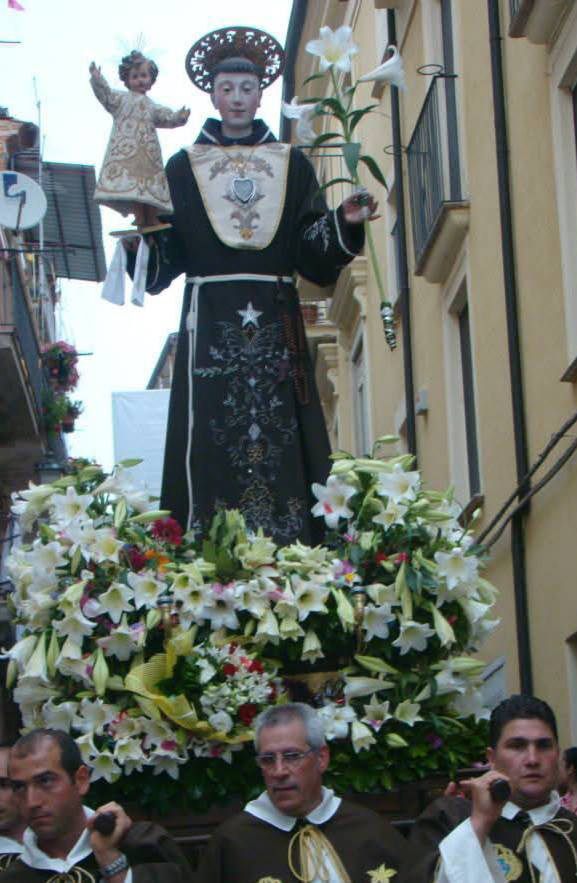
The procession of Saint Anthony of Padua in Nicastro (Lamezia Terme)
is a highly regarded historical and religious event, and its live
commentary has become a traditional event for the faithful,
especially those unable to attend in person.
Commentary Details and Reporters
Live television broadcasts, often broadcast on Essetivù channels (channel
112 or 98) and streamed on portals such as LameziaTerme.ite.it, have
long-standing collaborations with local professionals:
Massimo Mercuri: Production Manager (Emmeppi Produzioni Televisive),
generally hosts the live broadcast from the studio or main locations.
Giampiero Scarpino: Writer, reporter, and historical commentator, he
provides the liturgical commentary and the account of the key phases
of the procession of the statue.
Maria Scaramuzzino: Journalist, she assists Scarpino in commentary,
enriching the reporting with cultural and religious insights.
Field collaborators: The team often includes reporters among the
crowd, such as Massimo Iannicelli, Tonino Scalise, and Giovanni De
Grazia, to gather testimonies from devotees along the streets of
Nicastro.
The Statue of Saint Anthony: the simulacrum, of the Neapolitan
school, dates back to 1685 and is a unique statue depicting the
Saint wearing the habit of the Capuchin friars. It was commissioned
by the Venerable Father Antonio da Olivadi, then superior of the
Nicastro convent. The Procession traditionally takes place on June
14th. The statue is carried on the shoulders of the "statuari," a
hereditary privilege passed down from father to son. The Procession
is almost 500 meters long. A large turnout of the faithful follows,
and streets adorned with balconies for the Saint's passage. The
authorities and the historic Sebastiano Guzzi City of Lamezia Terme
music band, led by maestro Francesco Rotella, follow. Procession
Date: June 14, 2026 (following the tradition of having the
celebration on the 13th and the procession on the 14th).
* Start Time: Usually around 4:30-5:00 PM with the exit of the
statue preceded by fireworks.
* Location: Departure from the Sanctuary of Sant'Antonio, Colle di
Sant'Antonio, Nicastro (CZ).
* Where to watch: On EsseTV digital channels
From the square in front, you can admire a beautiful view of
Nicastro and the Riviera dei Tramonti, historically known as the
Gulf of the Feaci.
VAGLI DI SAMBIASE
The dialect term 'u vagliu originally referred to an arched entrance,
made of masonry or stone, that interrupted the continuity of buildings
to provide access from the street to a public internal courtyard, a
small space, or a vegetable garden. These elements represent an
ingenious solution of popular architecture, often born from the
fragmentation of ancient noble palaces between the late 19th and early
20th centuries.
Today, the vagli are the centerpiece of a tourist and cultural
development program.
* The Vagli Trail: A guided tour winds through the historic alleys,
visiting eight main vagli divided among the neighborhood's districts.
Among the most famous is the Atrio Fiorentino, located in the market
area.
In ancient times, the vagli were not just passageways, but actual places
of social gathering, lined with houses, shops, and cellars, the latter
bearing witness to the area's historic wine production.
* Cultural Events: The area hosts important events, such as the "Al
Vaglio. Books and Art in the Historic Center" festival, which transforms
these arches and their atriums into stages for literary presentations
and performances.
Vagli
* Atrio Fiorentino: Located on Via F. Fiorentino, a historic landmark in
the market district.
* Via Cavour: One of the most picturesque streets, known for its several
characteristic sieves.
* Casa di Franco Costabile: The famous poet is so closely linked to
these places that a cultural park dedicated to him has been proposed
right in the heart of Sambiase.
CHURCH OF SANTA CATERINA
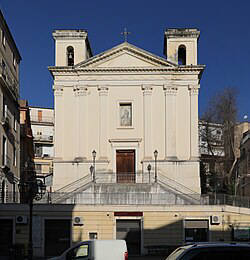
The Church of Santa Caterina d'Alessandria is a small Baroque gem
located in the heart of the historic center of Nicastro in Lamezia
Terme. It sits in an elevated position overlooking Corso Numistrano,
the city's main street, in the immediate vicinity of the Cathedral
of Saints Peter and Paul. The church is accessed via a striking
flight of steps leading from the street level to the building's
entrance. The neoclassical façade is very simple and linear,
enriched with pilasters with Corinthian capitals and a triangular
tympanum. The two small lateral turrets are distinctive features.
The interior, with a single nave, is richly decorated in Baroque and
late 18th-century style with stucco and cartouches. The barrel vault
houses three frescoes attributed to the Calabrian painter Francesco
Colelli.
The church is historically linked to the Confraternity of the
Immaculate Conception, which settled there around the 17th century.
It is also known for traditionally hosting celebrations in honor of
Saint Joseph in March and the Immaculate Conception of the Virgin
Mary in December.
Lamezia Terme, feast of Saint Joseph in the Church of Santa Caterina
d'Alessandria.
The wooden choir of the Church of Santa Caterina in Lamezia Terme (Nicastro)
is a valuable artistic work located in the apse area, behind the
high altar.
It is an elliptical choir. It is composed of a series of carved
stalls that follow the perimeter of the apse's curvature, designed
to harmonize with the building's Baroque architecture.
Artistic Context: Along with the choir, the church preserves other
notable wooden furnishings, including a pulpit located on the
Epistle side and a wooden compass on the counterfaçade.
Recently, the church's entire decorative apparatus, including the
wooden and marble choirs, has undergone conservative restoration
programs aimed at restoring the original polychrome work and
protecting the wood with woodworm treatments.
This choir is often confused with that of the nearby Cathedral of
Saints Peter and Paul, which instead houses an impressive
17th-18th-century wooden choir commissioned by bishops Cirillo and
Angeletti, created by master craftsmen from Rogliano.
THE FOUNTAINS OF LAMEZIA TERME
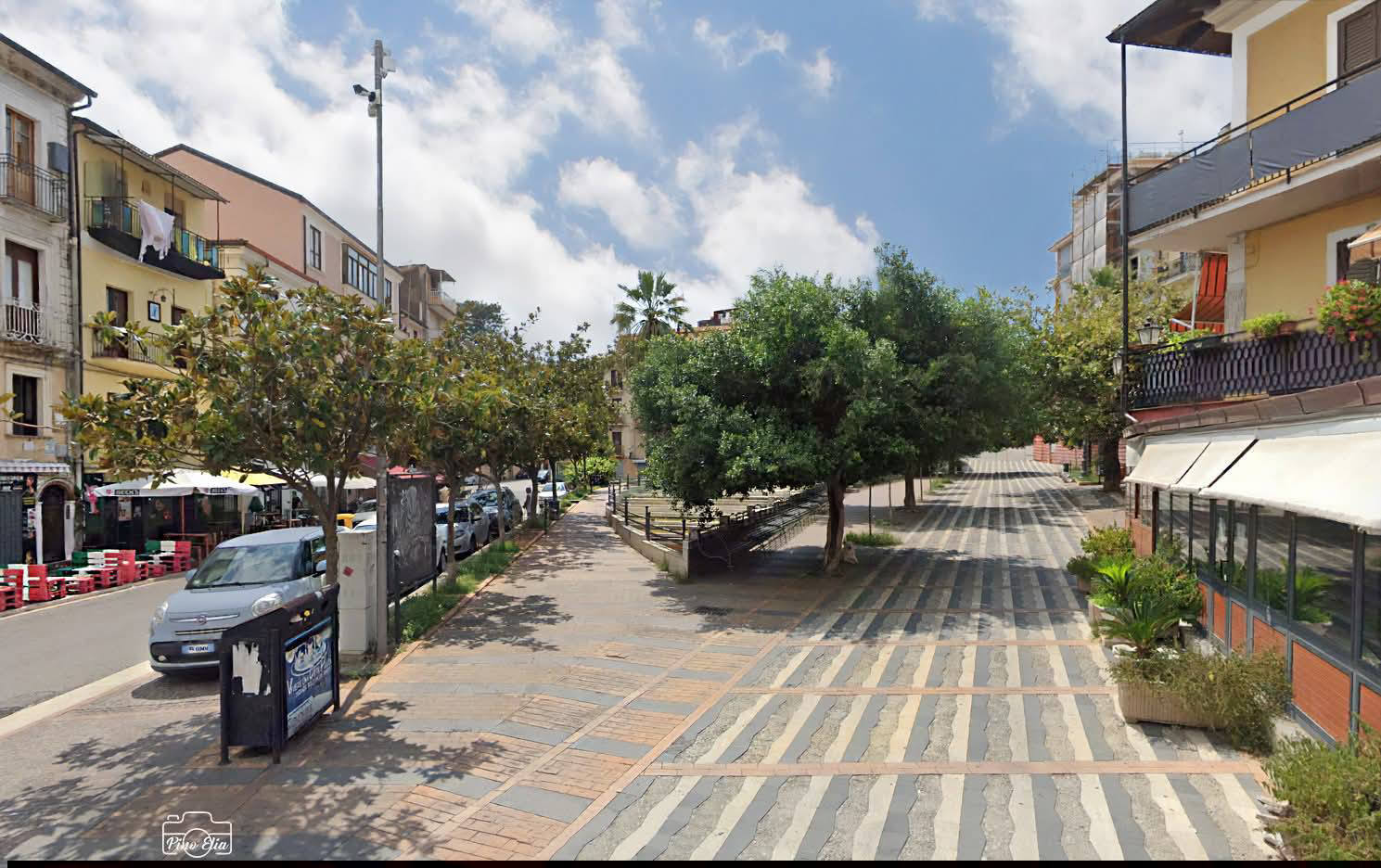
FONTANA PIAZZA MERCATO VECCHIO
Lamezia Terme boasts a rich heritage of historic and monumental
fountains, many of which are concentrated in the historic center of
Nicastro. These monuments are not just water supply points, but true
symbols of the city's identity and urban evolution.
Main Historic Fountains
Monumental Fountain in Piazza Mazzini (1838): Also known as the "New
Fountain" or the "Great Fountain," it was designed by engineer Basilio
Frangipane. Located in the heart of Nicastro, it is one of the most
impressive and visible in the city.
Historic Cafaldo Sambiase Fountain: Located on Via Cafaldo, this
18th-century fountain features a marble arch with an ancient inscription
commemorating Mayor Francesco Turco.
Foothill Fountain: Located in the San Teodoro neighborhood, it is one of
the oldest fountains and beloved by residents of the upper part of
Nicastro.
Chiusa Fountain: Listed by the FAI as one of the "Places of the Heart,"
it represents an important piece of local history located in the
historic Matrice neighborhood.
Niola Fountain: Another testimony to the past in the heart of Nicastro.
Fountains of the Pedestrian Area: In addition to the historic structures,
Lamezia Terme is home to numerous artistic fountains (about 30 in total)
created by various contemporary artists under the Lo Moro administration.
They are the work of various artists such as Cancello, La Pietra,
Panarello, Saladino, Trapasso, Robert, and Ricciardi, many of which were
restored in 2016.
Wide-ranging Heritage: It is estimated that the Lamezia Terme area
includes approximately 30 artistic fountains, of which 23 have undergone
major restoration work in recent years. Symbolism: In addition to their
aesthetic value, these fountains historically served as termination
points for aqueducts for urban water distribution.
Fountain of the Siren Ligea: Some local redevelopment proposals have
suggested enhancing the fountains in the pedestrian area of Corso
Giovanni Nicotera by naming them after the Siren Ligea, a mythological
figure linked to the origins of the Lamezia Terme plain, thus
symbolizing the local myth and identity. The "Non solo Trevi" project (developed
between 1998 and 2000) was the first "open-air museum" in Calabria. It
involved national and international artists in designing the sculptures/fountains,
and their construction was entrusted to the city's craftsmen
ANCIENT FAIRY MILL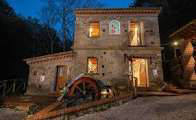
The Ancient Fairy Mill is a 17th-century watermill located in
Lamezia Terme (Nicastro), recently restored and transformed into a
cultural and educational center. Nestled in the Canne River valley,
at the foot of the Norman-Swabian Castle, the site combines the
revival of local traditions with sustainability and local promotion
initiatives.
* Directions: It can be reached from the provincial road to
Decollatura/Soveria, taking the small road in the Niola district
behind the Castle. The mill is about a 5-minute walk from the town
center.
* Contact: Phone/WhatsApp +39 328 136 5043.
* Opening Hours (April 2026):
* Monday: 10:00–12:30, 15:00–18:30
* Tuesday - Friday: 10:00–12:30, 16:00–17:30
* Saturday: 09:00–13:00, 15:30–17:30
* Sunday: Closed (except special events).
Managed by the non-profit association "Amici dell'Antico Mulino
delle Fate," the site offers various experiences:
* Traditional Milling: The mill uses a millstone with fine
19th-century French stone millstones for the cold-processing of
ancient grains.
* Bosco delle Fate: A natural woodland area along the Canne stream,
ideal for walks and "reconnecting" with nature.
* Library and Culture: Home to the "Don Vittorio Dattilo" library
and a permanent exhibition of antique machinery and period objects.
* Events and Legends: Activities are often linked to the legendary
figure of the Fairy Gelsomina and include educational workshops for
school groups, cultural events (such as "Macinare Cultura"), and
free events for families.
CHURCH OF ST. JOHN THE BAPTIST, SANTA EUFEMIA VETERE
The Church of St. John the Baptist was built after the terrible
earthquake of 1638, which caused the collapse and destruction of
numerous buildings throughout the Lamezia plain. The new religious
building was erected over the existing, ruined Church of St. Eufemia,
which housed the relics of the Saint, and was dedicated to St. John the
Baptist, patron saint of the Order of the Knights of Malta. It was Fra'
Signorino Gattinara, Bailiff of the Order of the Knights of Jerusalem,
who after the earthquake built a new church and housing for the monks
and farmers.
The parish of San Giovanni, with all its associated benefits, came under
the jurisdiction of the Diocese of Nicastro following the Concordat
between the Holy See and the Bourbon Government in 1818.
In 1931, the Fascist government carried out extensive renovations and
alterations, maintaining the original 17th-century layout and preserving
several important vestiges of the past, such as the four granite columns
located in the square in front of the church, which originate from the
ancient Benedictine Abbey of Sant'Eufemia.
Inside the church is a marble slab with a Latin epigraph, discovered
near the ruins of the Benedictine monastery. The inscription on the
stone confirms that the shrine inside the church contains the sacred
relics of Saint Euphemia, transported from Rhodes after the island was
conquered by the Turks.
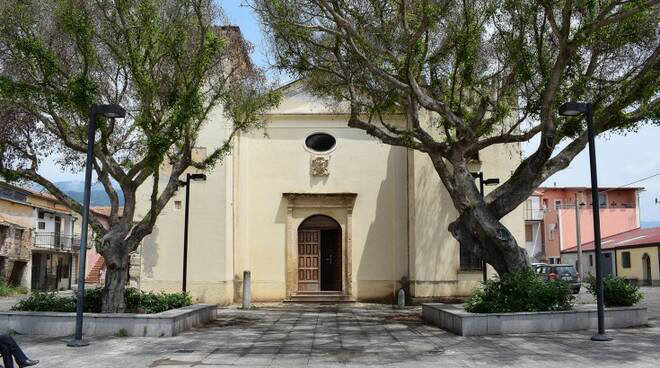
orges in the small village of Sant'Eufemia Vetere, located in a large,
tree-lined square. It features a simple gabled façade with a
round-arched tuff portal, above which is a coat of arms also carved in
tuff. On the right side of the building stands a crenellated tower,
while on the left stands the square-based bell tower, which houses a
sundial dating to 1931. The interior has a longitudinal layout with a
single nave and a trussed roof. Some frescoes depicting marble columns
dating from before restoration emerge from the smooth walls; on the
sides are four blind arches containing canvases of the Immaculate
Conception and Saint Stephen. In the presbytery, on the back wall is a
painting depicting the baptism of Jesus, attributed by some art
historians to the Calabrian painter Mattia Preti. The building was
constructed of traditional masonry with a pitched roof. The layout has a
longitudinal layout with a single nave. The roof is made of a wooden
truss substructure. The roof covering is made of brick tiles.
GRANDINETTI THEATRE
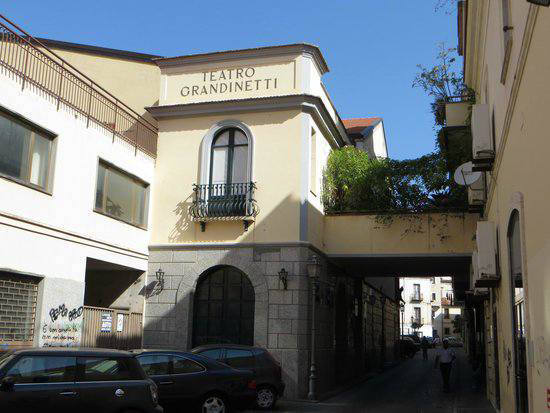
The Grandinetti Theatre in Lamezia Terme is the city's main cultural
center, located on Via Colonnello Cassoli in the Nicastro district.
Officially inaugurated in 1946 and subsequently acquired by the
Municipality in 2010, it now hosts important prose, music, and
children's theater festivals, with an authorized capacity of
approximately 600 seats.
The main festivals are organized by associations such as AMA Calabria
and I Vacantusi.
The Grandinetti Theatre in Lamezia Terme was built starting in 1935 by
the entrepreneur Francesco Grandinetti and inaugurated on January 6,
1946. On its façade is a bronze statue of Giangurgolo, the Calabrian
mask of the Commedia dell'Arte, by sculptor Maurizio Carnevali,
installed in 2010.
Giangurgolo, a typical Calabrian mask representing a greedy and chatty
character, with a statue by Maurizio Carnevali.
The theater was acquired and renovated by the Municipality of Lamezia
Terme.
The structure, often associated with the historic management of the
Grandinetti family, is an important cultural landmark in the city.
ITINERARIES TO SAN TEODORO AND THE CASTELLO
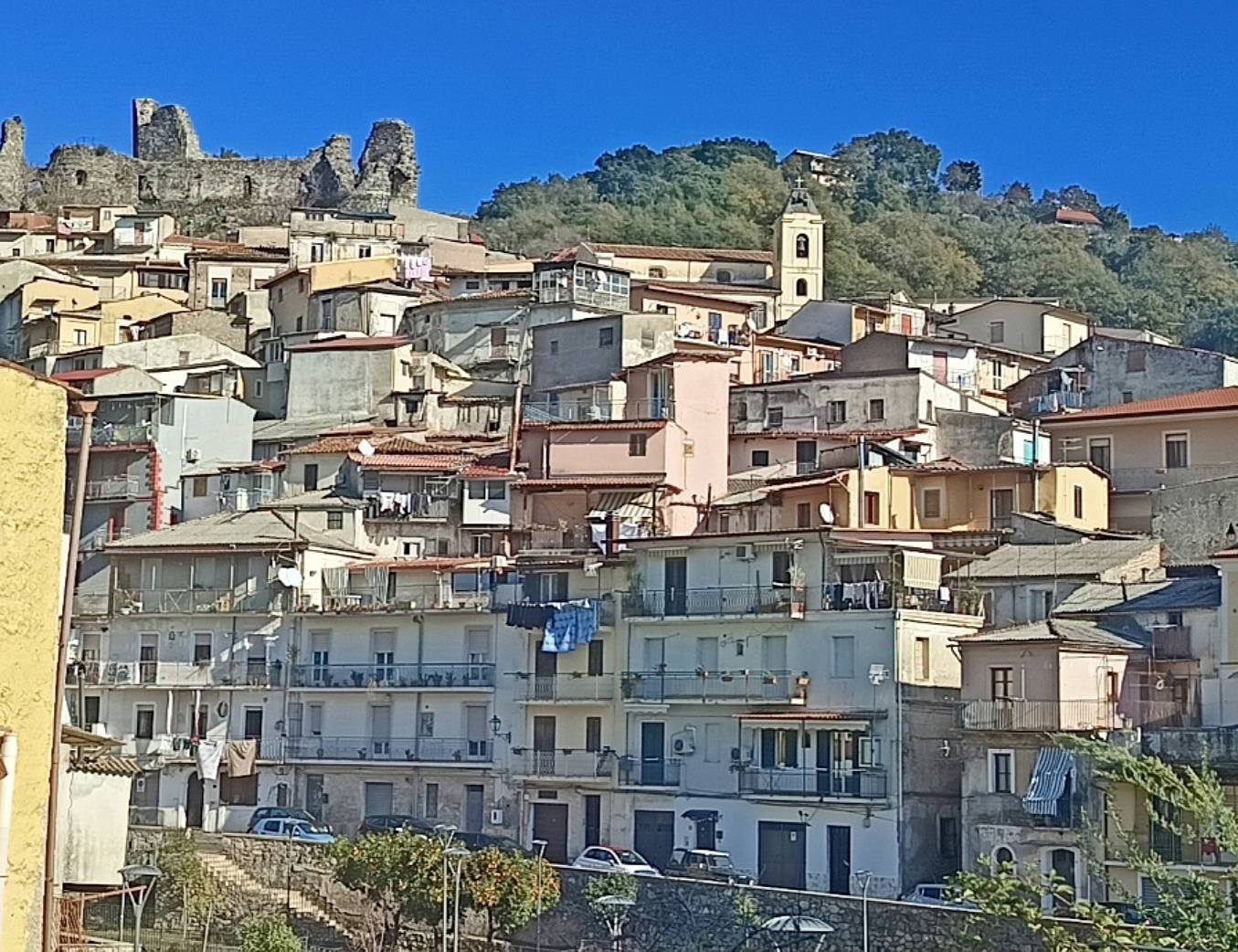
These places make up the historic heart of Nicastro, in the charming San
Teodoro district of Lamezia Terme. This is a perfect urban trekking
route, connecting the ancient castle area with the newly redeveloped
green spaces. [1, 2, 3]
Main Points of Interest
Piedichiusa Park: A redeveloped green oasis located between Via Federico
II and Via Santa Lucia, right at the foot of the Norman-Swabian Castle.
It is considered one of the most romantic spots in the city, ideal for
admiring the village from above, especially at night.
San Teodoro District: This is the oldest neighborhood in Nicastro,
characterized by medieval houses perched on the rock and narrow streets.
Here you can visit the Church of San Teodoro (14th century), which
houses the high altar of the Caracciolo family.
Via Garibaldi: A common starting point for excursions into the historic
center. This street is home to the statue of Frederick II of Swabia, who
chose the local castle as his residence and treasury.
The Climbs and Panoramic Streets:
Via Belvedere and Via Torre: Offer panoramic views of the Sant'Eufemia
plain and lead to the highest parts of the village.
Via dei Normanni: Access to the rear of the castle (currently only
accessible from the outside). From Via dei Normanni, you can photograph
the castle and the panorama.
SANTUARIO BEATA VERGINE DEL SOCCORSO
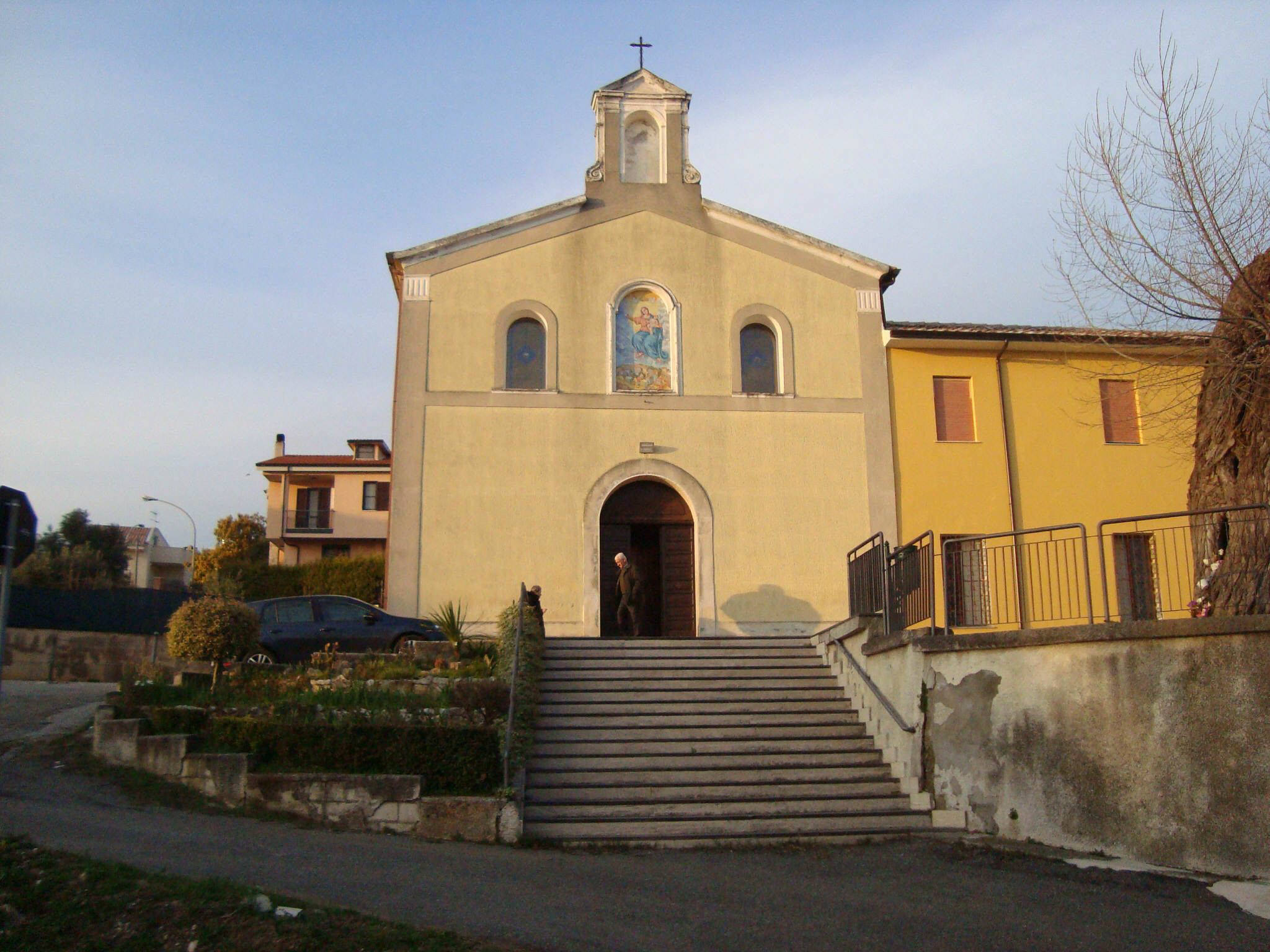
The view from the Church of the Madonna del Soccorso (located in the
Magolà district of Lamezia Terme) is one of the most evocative
vantage points on the Sunset Riviera. From the sanctuary's steps,
you can enjoy a breathtaking view that encompasses the entire
Lamezia plain, the historic district of San Teodoro, the Tyrrhenian
Sea, and, on clear days, the outline of the Aeolian Islands.
The overlook is famous for its sunsets over the sea, where the sun
seems to dive directly into the water. It is also a popular
destination on the night of San Lorenzo for stargazing.
The church was built in 1740. The Church of Santa Maria del Soccorso
houses an 18th-century wooden statue of the Neapolitan school,
depicting the Madonna protecting a little girl from the devil.
It is located a short distance from the center of Lamezia Terme (Nicastro
area), in an elevated position overlooking the Gulf of Sant'Eufemia.
The sanctuary is an integral part of the tourist and religious
itinerary of this stretch of the Calabrian coast, which extends from
Curinga to Nocera Terinese.
Recommended Walking Itinerary from the Cathedral to San Teodoro and the Castle.
FOTO FACE CENTRO STORICO NICASTRO
To best enjoy the area, you can follow this circular route:
Start: Via Garibaldi (Statue of Frederick II).
Ascent: Through the alleys of San Teodoro and Santa Lucia towards Via
Belvedere. Enter the alleys and photograph the narrow streets and sieves.
Visit the Timpone neighborhood.
Ascend from Santa Lucia, Largo Statti, and reach Albacin di Nicastro to
reach the Piedichiusa fountain.
Stop: Climb to Piedichiusa Park to relax among the urban gardens and
pedestrian paths.
Top: Through the narrow streets uphill, reach the ruins of the
Norman-Swabian Castle for a panoramic view. Along the way, visit the
Church of San Teodoro. Stop at the Niola fountain at the Mulino delle
Fate, on the bridge leading to the Madonna delle Cucchiarelle.
Return: Descent towards the Niola Fountain along the Canne stream.